
Written by the Real Homes Realty Property Management Team — specialising in residential property management across Western Sydney since [2026]. | Last updated: May 2026
Property management Western Sydney services have never been more important for landlords — or more complex. With vacancy rates sitting at just 2.0% across outer Western Sydney suburbs including Penrith and Blacktown, and median rents continuing to rise, the fundamentals for landlords have rarely been stronger.
Owning a rental property in Western Sydney is one of the most rewarding investments available in Australia right now. With vacancy rates sitting at just 2.0% across outer Western Sydney suburbs including Penrith and Blacktown, and median rents continuing to rise, the fundamentals for landlords have rarely been stronger.
Whether you self-manage or work with a professional agency, the information here will help you protect your asset, maximise your return, and stay compliant with NSW tenancy law.
What Is Property Management Western Sydney — and Why Does It Matter?
Property management is the professional administration of a rental property on behalf of the owner. A property manager handles the day-to-day relationship between landlord and tenant, covering everything from advertising vacancies and screening applicants to collecting rent, coordinating maintenance, conducting inspections, and managing legal compliance.
In Western Sydney specifically, professional property management matters more than in many other parts of Australia for several reasons:
- Tight rental market: With vacancy rates at 2.0% in Penrith, Blacktown, and surrounding suburbs, properties are leasing quickly — but tenant quality varies significantly. A rushed placement decision can cost thousands.
- Rapid law changes: The 2025 NSW rental reforms introduced sweeping changes to landlord and tenant rights. Staying compliant requires up-to-date knowledge that most self-managing landlords simply don’t have time to maintain.
- Diverse tenant pool: Western Sydney attracts one of the most diverse rental demographics in Australia — families, professionals, international students, essential workers, and new migrants — each with different needs and risk profiles.
- High growth, high stakes: With median rents for a 3-bedroom house ranging from $470 per week in Mount Druitt to $600 per week in Parramatta, even small management decisions translate to significant annual dollar differences.
A well-managed property in Western Sydney consistently outperforms a self-managed one over a 5-year period — not just in rent received, but in maintenance costs avoided, vacancy days minimised, and lease renewals secured.
- The Western Sydney Rental Market in 2026: What Landlords Need to Know
- How to Choose the Right Property Manager in Western Sydney
- Finding and Screening Quality Tenants
- Landlord Rights and Responsibilities Under NSW Law (2026)
- Managing Maintenance and Repairs
- Minimising Vacancy Periods in Western Sydney
- Self-Managing vs. Hiring a Property Manager: Making the Right Decision
- How to Handle Tenant Disputes and Use NCAT
- Getting a Free Rental Appraisal in Western Sydney
- Areas We Serve in Western Sydney
- External Resources for Western Sydney Landlords
The Western Sydney Rental Market in 2026: What Landlords Need to Know
Before diving into the management process, it’s worth understanding the market you’re operating in.
Vacancy Rates and Rental Demand
Western Sydney’s outer ring — encompassing Penrith, Blacktown, Campbelltown, and Liverpool — recorded a vacancy rate of approximately 2.0% in early 2026, according to SQM Research. While this is slightly higher than the crisis-level sub-1% rates seen in late 2023, it remains well below the 2.5% considered a balanced market. Rental demand in the region continues to be driven by population growth, the Western Sydney Airport development corridor, and affordability pressure pushing tenants out of inner and middle Sydney.
Median Rents by Suburb (Q1 2026)
| Suburb | 2BR Unit (median/wk) | 3BR House (median/wk) |
|---|---|---|
| Parramatta | $500 | $600 |
| Blacktown | $440 | $530 |
| Penrith | $420 | $510 |
| Auburn | $460 | $560 |
| Granville | $430 | $530 |
| Mount Druitt | $390 | $470 |
Source: SQM Research, Q1 2026 median asking rents
Rental Yields
Western Sydney units are delivering some of the strongest rental yields in Sydney. Units in suburbs like Auburn, Granville, and Merrylands are achieving gross yields of 5.8% to 6.6%, while houses in Blacktown and St Marys sit around 3.1% to 3.5% — modest by national standards but supported by consistent capital growth.
Property Management Western Sydney Fees: What to Expect in 2026
Understanding property management Western Sydney fee structures is the first step to evaluating any property manager.
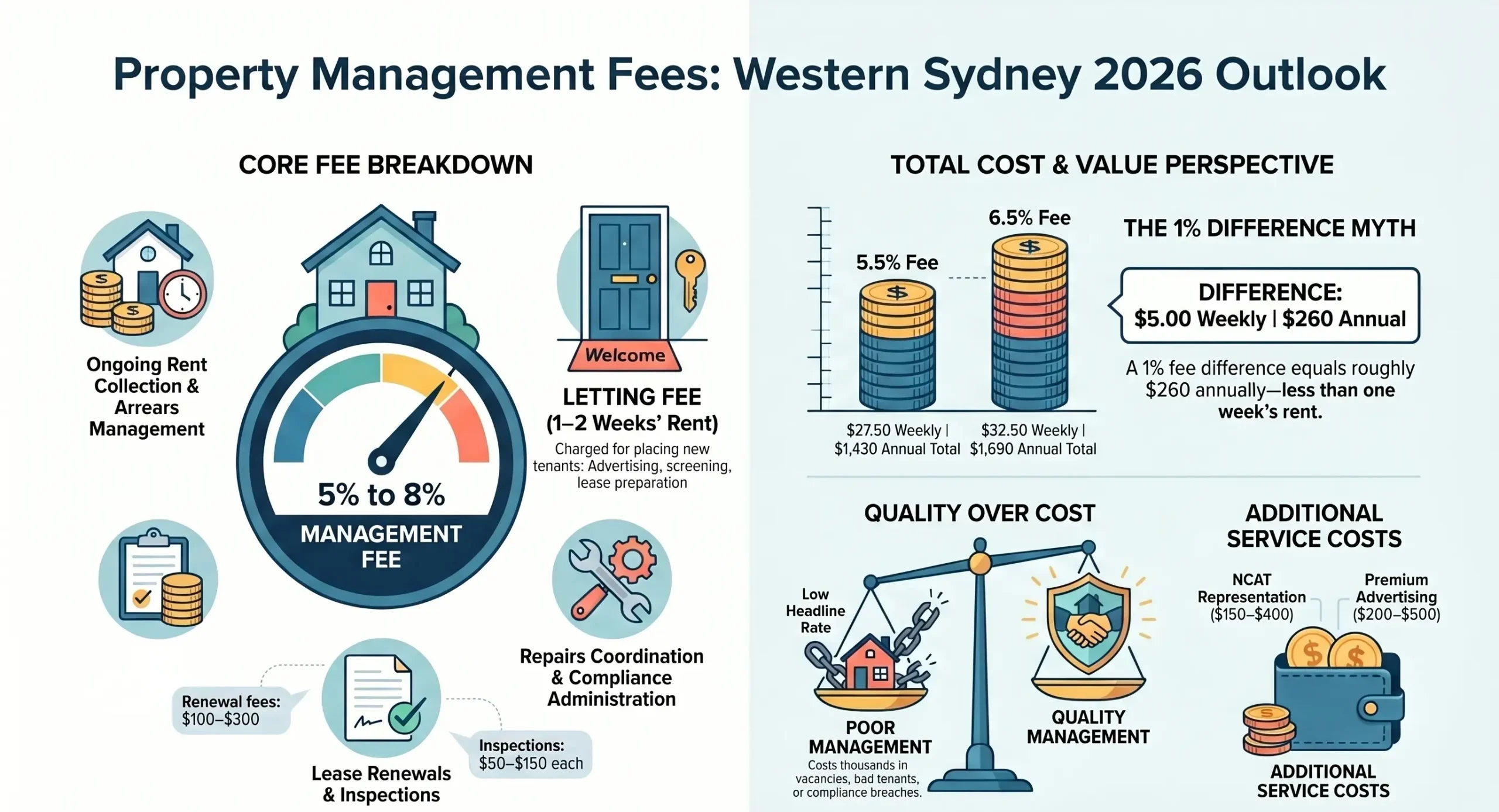
For Western Sydney specifically, expect fees in the 5% to 8% range, with the following breakdown:
The Core Fee Structure
Management fee (ongoing): 5% to 8% of rent collected — this covers rent collection, arrears management, routine repairs coordination, tenant communication, and compliance administration. On a $500/week property, a 6% management fee equals $30 per week, or $1,560 annually.
Letting fee (one-off per tenancy): Typically 1 to 2 weeks’ rent — charged when a new tenant is placed. This covers advertising, open homes, tenant screening, reference checks, lease preparation, and bond lodgement.
Lease renewal fee: $100 to $300 — charged when an existing tenant renews their lease.
Routine inspection fee: $50 to $150 per inspection — some agencies include a set number per year in their management fee, others charge per visit. Confirm before signing.
Additional fees to watch for: NCAT representation ($150–$400), end-of-year statement ($50–$100), advertising ($200–$500 for premium listings), and tribunal filing costs.
What a 1% Fee Difference Actually Costs You
On a $500/week Western Sydney property, the difference between a 5.5% and a 6.5% management fee is approximately $260 per year. This is less than one week’s rent. The real cost of a poor property manager — a bad tenant, an extended vacancy, a missed maintenance issue, or a tenancy compliance breach — can easily run to thousands. Always compare what’s included, not just the headline percentage.
How to Choose the Right Property Manager in Western Sydney
Not all property managers are equal. Here’s what to evaluate before signing a management agreement.
Local Knowledge
A property manager who specialises in Western Sydney will understand the rental demand patterns across Penrith, Blacktown, Kellyville, Jordan Springs, and surrounding suburbs — including which streets rent quickly and which sit vacant, and what tenants in each area are willing to pay.
Portfolio Size Per Manager
Ask how many properties each property manager personally manages. The industry standard is around 100 to 150 properties per manager. If the ratio is 200+ properties per person, your investment will not receive the attention it needs.
Communication and Responsiveness
A simple test: how quickly does the agency respond to your initial enquiry? Slow or impersonal responses at the sales stage are a reliable indicator of how they’ll manage your property once you’ve signed.
Technology and Reporting
Look for agencies offering an online landlord portal with real-time access to rent statements, maintenance requests, and inspection reports. Transparency in reporting is a sign of a well-run operation.
Fee Transparency
Before signing, request a complete schedule of all fees — including the less visible charges for inspections, lease renewals, advertising, and NCAT attendance. An agency unwilling to provide this upfront is one to avoid.
Questions to Ask Every Agency
- How many properties does each property manager in your team personally manage?
- What is your average vacancy period for properties in my suburb?
- How do you screen and reference-check tenant applications?
- What happens if rent falls into arrears?
- Do you use a preferred trades panel? Can I nominate my own tradespeople?
- What notice do you give tenants before routine inspections?
- How do you handle repairs below my pre-approved maintenance threshold?
Finding and Screening Quality Tenants
Tenant selection is the single most important decision in property management. A reliable, long-term tenant in a Western Sydney property protects your investment, minimises vacancy, and reduces maintenance costs.
How Property Managers Advertise Your Property
Professional property management Western Sydney services matter more than in many other parts of Australia. Premium listings with professional photography consistently reduce days on market and attract stronger applicants. In Western Sydney’s 2% vacancy market, well-presented properties with clear descriptions and quality photos typically receive multiple applications within the first week.
The Tenant Screening Process
A thorough screening process evaluates:
Income and employment verification: Most agencies require tenants to demonstrate a weekly income of at least three times the weekly rent. Pay slips, bank statements, and employment confirmation letters are standard requirements.
Rental history: Reference checks with previous property managers or landlords confirm payment reliability, property care, and whether the tenancy ended on good terms.
Identification: 100 points of ID is standard, with photo ID as the primary document.
TICA and National Tenancy Database: These national databases flag tenants with previous tenancy defaults, court orders, or unpaid rent — a critical check often overlooked by self-managing landlords.
Tenant Risk Assessment
The best tenant isn’t always the one who can afford the rent — it’s the one who has a stable, consistent track record of doing so. Employment type matters less than consistency: a self-employed applicant with three years of bank statements showing regular income can be a stronger choice than a casual employee with only one month’s pay slips.
Landlord Rights and Responsibilities Under NSW Law (2026)
The Residential Tenancies Amendment Act 2024, which came into full effect on 19 May 2025, introduced the most significant changes to NSW tenancy law in a generation. Every Western Sydney landlord needs to understand these reforms.
What Changed for Landlords
No-grounds evictions are now unlawful. You can no longer end a tenancy without a legally recognised reason. Valid grounds include significant renovation or demolition, sale of the property requiring vacant possession, the landlord or an immediate family member moving in, or a tenant breach of the agreement.
Minimum notice periods have increased. For periodic tenancies and fixed-term leases over six months, you must give at least 90 days’ notice — up from 60 days. For breach of agreement, the notice period is 14 days.
Rent increases are capped at once per 12 months. This applies to all lease types. You must give at least 60 days’ written notice before any increase takes effect.
Pet bans are no longer enforceable. You must respond to a pet application within 21 days. Silence equals automatic approval. You can only refuse for specific prescribed reasons — not general preference.
Fee-free payment required. You must offer at least one fee-free payment method (bank transfer). From March 2026, Centrepay must be accepted if the tenant requests it.
Landlord Disclosure Obligations
Before signing a new tenancy agreement, you are legally required to disclose:
- Any flooding or fire damage to the property in the last five years
- Any major crime that occurred at the property
- Any easement that allows third-party access
- Whether an order has been made requiring rectification of defects
Failure to disclose can result in the tenant having grounds to terminate the agreement without penalty.
Routine Inspections
You may conduct a maximum of four routine inspections per year. Each requires at least seven days’ written notice. Entry without proper notice — even in good faith — is a breach of the tenant’s right to quiet enjoyment and can result in a complaint to NSW Fair Trading.
Managing Maintenance and Repairs
Maintenance is where property management quality becomes most visible — both to tenants and to the long-term value of your asset.
Urgent Repairs
Under NSW tenancy law, a landlord must attend to urgent repairs immediately. Urgent repairs include burst water pipes, gas leaks, dangerous electrical faults, broken locks, flooding, and failure of essential services like hot water or heating. A tenant whose landlord fails to address urgent repairs has the right to organise the repair themselves (up to a prescribed amount) and deduct the cost from rent.
Routine Maintenance
Non-urgent maintenance requests should be acknowledged within 48 hours and resolved within a reasonable timeframe — typically within 14 business days for non-critical issues. Delays in routine maintenance erode tenant satisfaction, increase the likelihood of a lease non-renewal, and can allow minor issues to escalate into major structural problems.
The Cost of Deferred Maintenance
A dripping tap costs around $150 to fix. Left for six months, the water damage to the cabinet beneath can run to $1,500. A cracked roof tile costs $200 to replace. Left through a wet Western Sydney winter, the resulting internal water damage can cost $8,000+. Proactive maintenance is not an expense — it is asset protection.
Building a Maintenance System
Professional property managers maintain a vetted panel of licensed tradespeople — plumbers, electricians, carpenters, and general handymen — who can respond quickly and reliably. Ask your property manager whether they mark up tradesperson invoices (some agencies do), and whether you can nominate your own preferred contractors.
Minimising Vacancy Periods in Western Sydney
Every day your property sits vacant is a day of lost income. At $500 per week, a two-week vacancy costs you $1,000. A six-week vacancy costs $3,000 — more than a full year of management fees.
Average Vacancy Periods
In Western Sydney’s current market, well-presented properties managed by active agencies are typically tenanted within one to three weeks of listing. Properties that sit vacant for longer generally share a common set of issues: overpriced rent, poor photography, inadequate advertising, or a property condition that does not meet tenant expectations.
How to Minimise Vacancy
Price the property correctly from day one. Overpricing by $30 per week will not result in a higher-paying tenant — it will result in three weeks of vacancy, costing you $90 in lost income for every $30 of attempted gain. A good property manager will provide a current market rental appraisal based on recent comparable listings, not aspirational figures.
Invest in presentation. Professional photography, a clean property, and fresh paint where needed consistently reduce days on market. First impressions in realestate.com.au listings are made in seconds.
Start advertising before the current tenant vacates. A property manager who lists the property only after the current tenant moves out is adding unnecessary vacancy days. Most agencies should begin advertising 4 to 6 weeks before the end of a lease.
Prioritise lease renewals. The cheapest tenancy is a renewed one. Avoiding vacancy and re-letting fees by retaining a good tenant — even with a modest rent increase — is almost always the better financial outcome.
Self-Managing vs. Hiring a Property Manager: Making the Right Decision
Some landlords in Western Sydney choose to self-manage their properties — particularly those who own nearby or who have a background in property. Here’s an honest assessment of both approaches.
The Case for Professional Property Management
Time: Managing a rental property competently requires between 5 and 10 hours per month — more when vacancies, maintenance issues, or disputes arise. For most working landlords, this time has a significant opportunity cost.
Legal risk: NSW tenancy law changed materially in 2025 and continues to evolve. A single compliance breach — failing to lodge a bond correctly, issuing an invalid termination notice, or conducting an inspection without proper notice — can result in financial penalties and tribunal orders.
Tenant relationships: At arm’s length management reduces the emotional difficulty of rent arrears conversations, inspection disputes, and end-of-tenancy bond claims. A professional manager handles these as standard procedure, not personal conflict.
Scale: If you own more than one investment property, self-management becomes a part-time job. Professional management scales without the same time burden.
The Case for Self-Management
Self-management can work well for landlords who: live close to the property, have time to stay across NSW tenancy law, have existing relationships with reliable tradespeople, and have direct experience managing tenant relationships professionally.
The risks increase significantly for interstate owners, time-poor professionals, landlords with multiple properties, and those unfamiliar with NCAT processes and NSW Fair Trading requirements.
How to Handle Tenant Disputes and Use NCAT
Even with excellent tenant selection and proactive management, disputes arise. Knowing the correct process protects both your legal rights and your relationship with the tenant.
Common Disputes in Western Sydney Rentals
- Rent arrears (most common)
- Bond claim disputes at end of tenancy
- Property damage beyond fair wear and tear
- Unauthorised modifications or subletting
- Tenants refusing inspection access
The Correct Process
Step 1: Issue a written notice to the tenant detailing the issue and the required action.
Step 2: If unresolved, contact NSW Fair Trading for free conciliation and mediation services.
Step 3: If mediation fails, apply to the NSW Civil and Administrative Tribunal (NCAT) for a formal hearing.
NCAT is the legally designated body for resolving residential tenancy disputes in NSW. It is accessible, low-cost, and the outcomes are legally enforceable. For non-payment of rent, a property manager can apply for a termination and possession order — typically heard within two to three weeks of application.
Getting a Free Rental Appraisal in Western Sydney
If you’re considering renting out a property in Western Sydney, or if you want to check whether your current rent reflects the market, a professional rental appraisal is your starting point.
A rental appraisal from a local agency covers:
- Current market rent range for your property type and location
- Recent comparable listings and how long they took to lease
- Recommended presentation improvements before listing
- An overview of the current tenant demand profile in your suburb
- An honest assessment of the management fees and service included
At Real Homes Realty, we provide free rental appraisals across Western Sydney — including Penrith, Blacktown, Parramatta, Kellyville, Jordan Springs, Schofields, Cranebrook, and Claremont Meadows. There is no obligation to proceed, and the appraisal is based on current market data, not aspirational figures.
Why Choose Our Property Management Western Sydney Team
Real Homes Realty specialises in residential property management Western Sydney services, including Penrith, Blacktown, Parramatta, Kellyville, Jordan Springs, Schofields, Box Hill, and Claremont Meadows.
Our property management service includes:
- Free rental appraisal with current market data
- Professional photography and premium listings on realestate.com.au and domain.com.au
- Thorough tenant screening including TICA database checks
- Regular routine inspections with detailed photo reports
- 24/7 emergency maintenance coordination
- Full NSW tenancy law compliance management
- Transparent monthly statements via your online landlord portal
- Proactive lease renewal management to minimise vacancy
We manage your investment as if it were our own — because we know that your financial future depends on it.
👉 Get a free rental appraisal for your Western Sydney property 👉 Contact our property management team today
Areas We Serve in Western Sydney
Real Homes Realty provides property management across Western Sydney including dedicated suburb guides for:
– Glenmore Park
– South Penrith
– Kingswood
– Jamisontown
– Jordan Springs
– Penrith
External Resources for Western Sydney Landlords
- NSW Fair Trading — Rental Law Changes 2025
- NCAT — Residential Tenancy Disputes
- Rental Bonds Online — Lodge and Manage Your Bond
- Landlord Guide — NSW Fair Trading
This guide is updated regularly to reflect current NSW tenancy law and Western Sydney market conditions. For personalised advice on your investment property, contact the Real Homes Realty property management team.