
Written by the Real Homes Realty Property Management Team | Last updated: May 2026
Rental yield Western Sydney investors achieve in 2026 tells a more complex story than most buyers realise. While Sydney-wide averages often dominate the conversation, the real yield opportunity sits in Western Sydney’s unit market, where affordable entry prices, tight vacancy rates, and rising rents are producing strong returns.
This guide breaks down rental yield across Western Sydney suburb by suburb — houses and units separately — explains the difference between gross and net yield, shows you how to calculate your real return, and gives you a clear picture of where the best risk-adjusted opportunities sit in 2026.
Understanding rental yield Western Sydney investors can realistically achieve is essential before purchasing any investment property in 2026.
For a broader overview of property management across Western Sydney, read our Complete Guide to Property Management in Western Sydney (2026).
- What Is Rental Yield and Why Does It Matter?
- Rental Yield Western Sydney: Suburb-by-Suburb Breakdown
- Western Sydney Rental Yield by Suburb: 2026 Data
- Gross vs Net: What Your Real Return Looks Like
- The Yield vs Growth Trade-off in Western Sydney
- How to Calculate Your Yield Before You Buy
- What Vacancy Rate Means for Your Yield Calculation
- Houses vs Units: Making the Right Call for Western Sydney
- Tax and Depreciation: Boosting Your After-Tax Return
- Get a Free Rental Appraisal Before You Invest
What Is Rental Yield and Why Does It Matter?
Rental Yield Western Sydney: Suburb-by-Suburb Breakdown
Rental yield is the annual rental income generated by a property expressed as a percentage of its purchase price. It is the most widely used measure of a property’s income-generating performance and the starting point for any serious investment analysis.
There are two types of yield that every Western Sydney investor needs to understand:
Gross Rental Yield
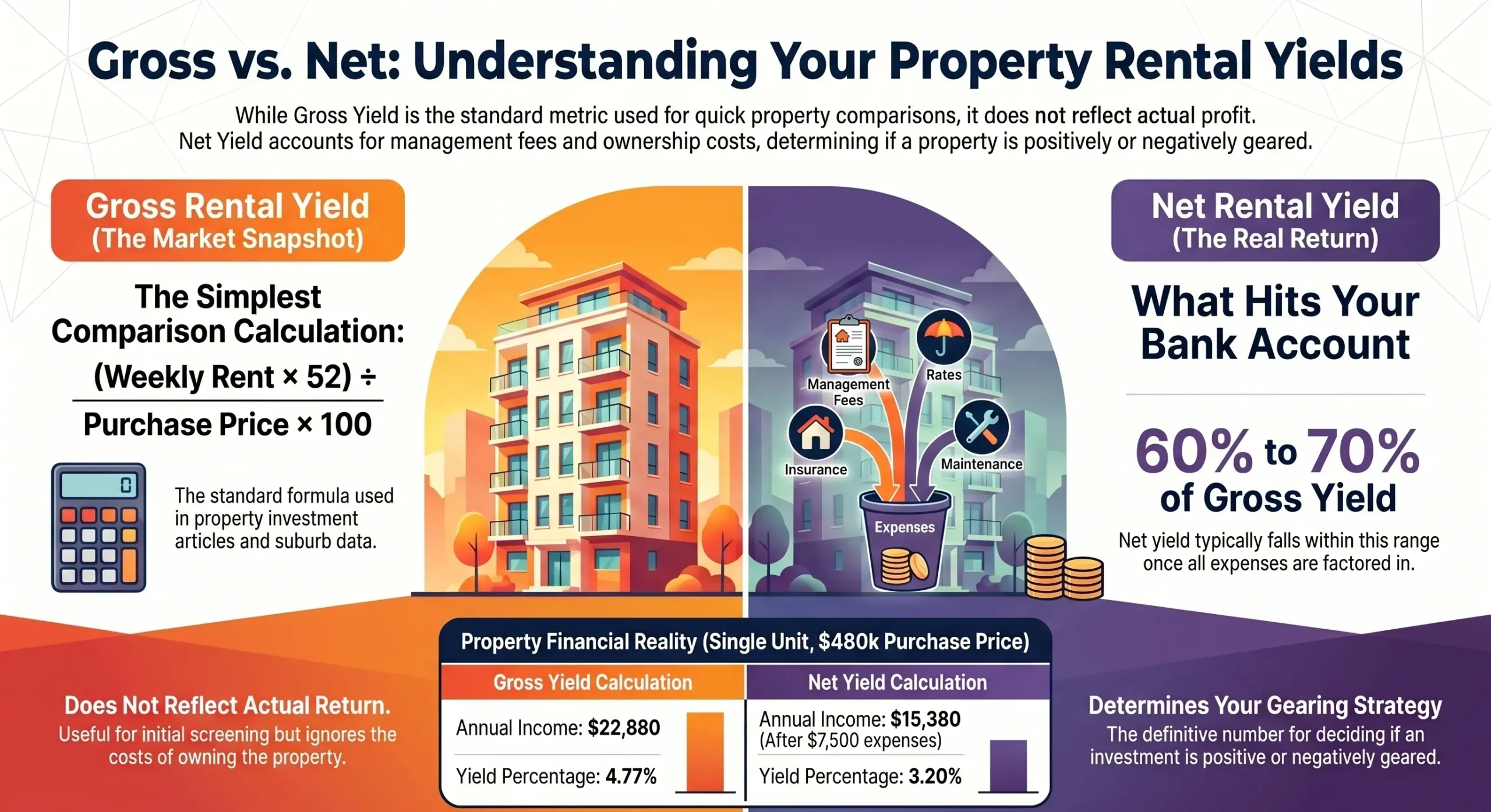
Gross yield is the simplest calculation — annual rent divided by purchase price, multiplied by 100.
Formula:
Gross Yield = (Weekly Rent × 52) ÷ Purchase Price × 100
Example — Blacktown unit:
- Weekly rent: $440
- Annual rent: $22,880
- Purchase price: $480,000
- Gross yield: ($22,880 ÷ $480,000) × 100 = 4.77%
Gross yield is the number most commonly quoted in property investment articles and suburb comparisons. It is useful for quick comparisons but does not reflect your actual return.
Net Rental Yield
Net yield accounts for all the costs of owning and managing the property — management fees, council rates, insurance, water rates, maintenance, landlord insurance, and property agent costs. Typically, net yield runs at 60% to 70% of gross yield once all expenses are factored in.
Formula:
Example — same Blacktown unit:
- Annual rent: $22,880
- Annual expenses: $7,500 (management fees, rates, insurance, maintenance)
- Net annual income: $15,380
- Net yield: ($15,380 ÷ $480,000) × 100 = 3.20%
Net yield is what actually hits your bank account. It is the number that determines whether your investment is positively geared, negatively geared, or roughly neutral.
Why Western Sydney Stands Out
The average rental yield across Sydney in 2026 sits at approximately 2.6% for houses and 4.0% for units — but Western Sydney’s unit market
significantly outperforms this average.
The Sydney-wide average house yield sits around 2.6% gross — one of the lowest of any major city in Australia. Western Sydney units are where the yield story actually sits, and Western Sydney units are where it’s strongest, with gross yields of 5.8% to 6.6% in Auburn, Granville, and Merrylands — driven by lower entry prices combined with solid rents.
This makes Western Sydney — specifically its unit markets — one of the most compelling yield environments in metropolitan Australia.
Western Sydney Rental Yield by Suburb: 2026 Data
The following figures are based on current market data for Q1–Q2 2026. Yields are gross unless stated otherwise.
Houses
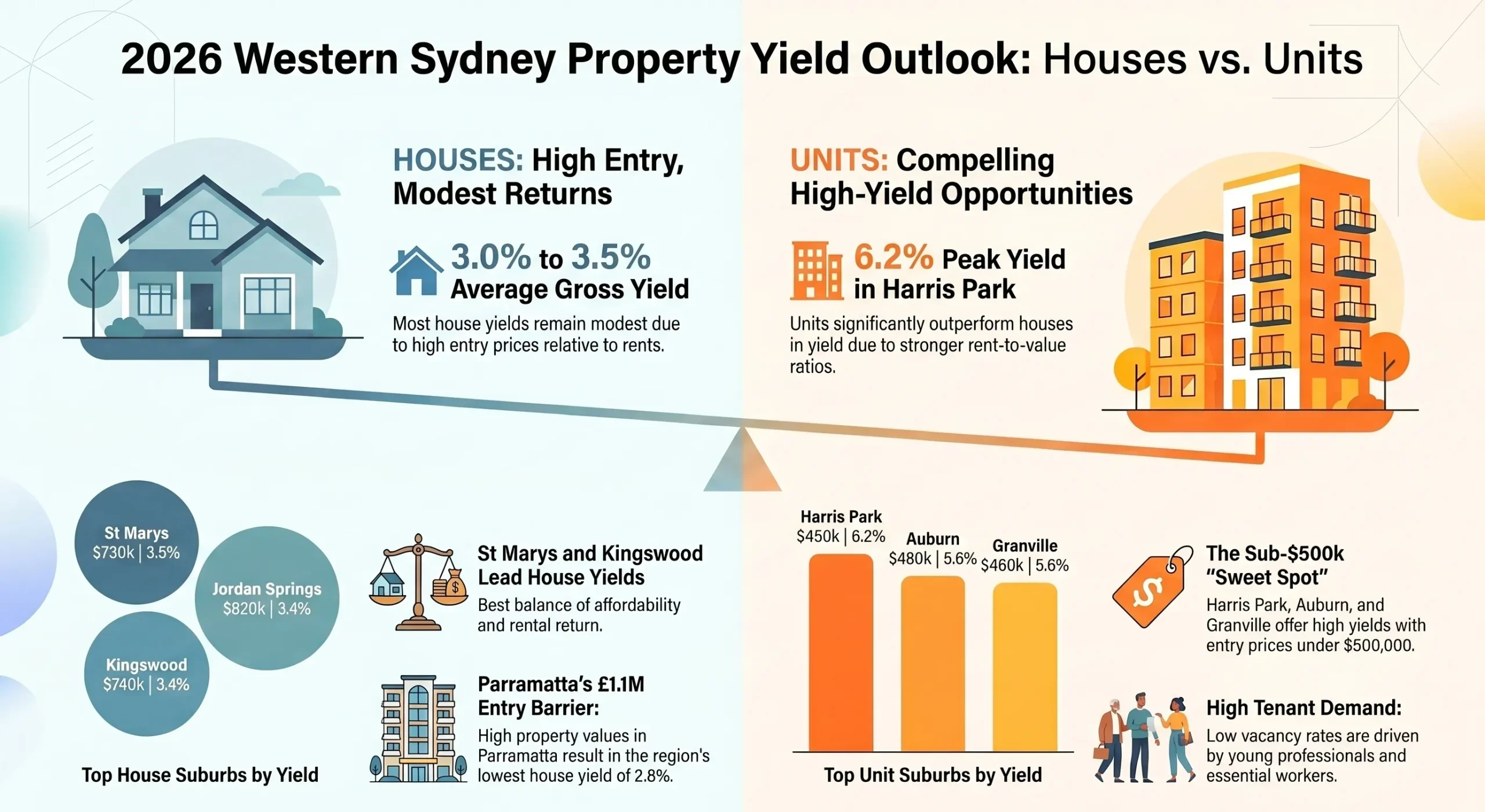
Western Sydney houses in suburbs like Blacktown, Mount Druitt, and St Marys are delivering 3% to 3.5% gross yield. Blacktown is currently around 3.1% at a $595 to $630 per week median rent. Mount Druitt sits closer to 2.5% to 3% at a $546 to $550 per week median rent.
Rental yield Western Sydney house investors receive varies significantly depending on suburb, vacancy rates, and property prices.
| Suburb | Median House Price | Median Weekly Rent | Gross Yield |
|---|---|---|---|
| Jordan Springs | $920,000 | $600 | 3.4% |
| Penrith | $880,000 | $510 | 3.0% |
| Blacktown | $950,000 | $570 | 3.1% |
| St Marys | $730,000 | $490 | 3.5% |
| Kingswood | $740,000 | $480 | 3.4% |
| Mount Druitt | $750,000 | $470 | 3.3% |
| Parramatta | $1,100,000 | $600 | 2.8% |
| Quakers Hill | $900,000 | $530 | 3.1% |
| Glenmore Park | $870,000 | $510 | 3.0% |
Source: Compiled from SQM Research, OpenAgent and Australian Property Experts, Q1 2026
House yields across Western Sydney are modest by national standards — reflecting Sydney’s high entry prices relative to rents. The strongest house yield play is in St Marys and Kingswood, where prices remain below $750,000 and rents have held firm. Kingswood and St Marys offer the most affordability at $720,000 to $750,000 medians and highest yields at 4.8% to 5.1% — though these come with rougher demographics and older housing stock, making them higher-risk plays suited to experienced investors.
Units
Units are where Western Sydney’s yield story becomes genuinely compelling. Blacktown and Harris Park apartments are delivering strong results for investors, with yields exceeding 6.3% and median sale prices remaining relatively affordable for the Sydney market at under $500,000.
Rental yield Western Sydney unit investors achieve is generally higher than houses due to lower entry prices and stronger rent-to-value ratios.
| Suburb | Median Unit Price | Median Weekly Rent | Gross Yield |
|---|---|---|---|
| Harris Park | $450,000 | $540 | 6.2% |
| Auburn | $480,000 | $520 | 5.6% |
| Granville | $460,000 | $500 | 5.6% |
| Merrylands | $490,000 | $510 | 5.4% |
| Blacktown | $480,000 | $440 | 4.8% |
| Werrington | $677,500 | $460 | 3.5% |
| Parramatta CBD | $580,000 | $550 | 4.9% |
| Penrith | $520,000 | $420 | 4.2% |
| Kingswood | $500,000 | $430 | 4.5% |
Source: OpenAgent, Australian Property Experts, Property Investment Professionals, Q1 2026
The standout performers for pure yield are Harris Park, Auburn, Granville, and Merrylands — all delivering gross yields above 5.5% at entry prices well below $500,000. These suburbs attract a diverse tenant base of young professionals, families, and essential workers with consistent demand and low vacancy.
Gross vs Net: What Your Real Return Looks Like
The gap between gross and net yield is where many first-time investors are caught out. Here is a worked example for two of Western Sydney’s most common investment scenarios.
Scenario 1 — Blacktown Unit at $480,000
| Item | Annual Amount |
|---|---|
| Gross rent (52 weeks × $440) | $22,880 |
| Property management fees (6.5%) | −$1,487 |
| Council rates | −$1,200 |
| Water rates | −$900 |
| Landlord insurance | −$1,400 |
| Maintenance and repairs | −$1,500 |
| Letting fee (amortised over 2 years) | −$275 |
| Net annual income | $16,118 |
| Gross yield | 4.77% |
| Net yield | 3.36% |
Scenario 2 — Auburn Unit at $480,000
| Item | Annual Amount |
|---|---|
| Gross rent (52 weeks × $520) | $27,040 |
| Property management fees (6.5%) | −$1,758 |
| Council rates | −$1,200 |
| Water rates | −$900 |
| Landlord insurance | −$1,400 |
| Maintenance and repairs | −$1,500 |
| Letting fee (amortised over 2 years) | −$325 |
| Net annual income | $19,957 |
| Gross yield | 5.63% |
| Net yield | 4.16% |
The Auburn unit generates $3,839 more net income per year on the same purchase price — purely from higher rent. Over five years, that is more than $19,000 in additional after-expense income before any capital growth difference is considered.
The Yield vs Growth Trade-off in Western Sydney
Every investor faces the same fundamental choice: optimise for yield now, or accept a lower yield in exchange for stronger capital growth over time. Western Sydney in 2026 offers a range of options across this spectrum.
High Yield, Moderate Growth
Best suburbs: Auburn, Granville, Harris Park, Merrylands
These suburbs deliver the strongest gross yields in Western Sydney — 5.5% to 6.5% for units — with moderate capital growth. They suit investors who need positive or near-positive cash flow, particularly those with higher borrowing costs in the current rate environment.
The trade-off: capital growth has been solid but not spectacular. These are established middle-ring suburbs without a major infrastructure catalyst driving rapid price appreciation.
Balanced Yield and Growth
Best suburbs: Blacktown, Parramatta, Quakers Hill
Parramatta is a dual-economy suburb, residential hub, and Sydney’s officially recognised Second CBD — with billions in infrastructure spending transforming the suburb. The Parramatta Light Rail, Sydney Metro West and the expansion of the health, legal and education precincts make it one of the most future-proof markets in NSW. Yields here are in the 4.5% to 5% range for units — lower than Auburn — but the capital growth story is stronger.
Quakers Hill has strong fundamentals — close to major employment hubs at Norwest, Blacktown, and Parramatta, good schools, T1 rail line, and an established family demographic — with vacancy rates very tight at 1% to 1.5%.
Lower Yield, High Growth Potential
Best suburbs: Jordan Springs, Penrith, Glenmore Park
Penrith offers the best combination of affordability at $880,000 median, yield at 4.5%, and infrastructure catalyst from the Western Sydney Airport. Jordan Springs at 9.2% annual growth — despite being Penrith’s most expensive suburb at $920,000 median — attracts professional families and has low investor ratios under 20%, driving strong owner-occupier demand.
The trade-off: Penrith is genuinely a 10 to 20 year play. Meaningful job creation from the airport happens over decades, not instantly. If you need results in 3 to 5 years, Penrith may not be the right choice.
How to Calculate Your Yield Before You Buy
Before purchasing any Western Sydney investment property, run these calculations:
Step 1 — Establish Current Market Rent
Contact a local property manager for a rental appraisal based on current comparable listings. Do not rely on listed asking rents — use recently leased properties of similar size and condition in the same suburb. A rental appraisal from Real Homes Realty is free and obligation-free.
Step 2 — Calculate Gross Yield
Gross Yield = (Weekly Rent × 52) ÷ Purchase Price × 100
Anything above 4.5% gross in Western Sydney is a solid starting point. Above 5.5% on a unit is excellent.
Step 3 — Estimate Annual Expenses
Use these benchmarks for a Western Sydney investment property:
| Expense | Annual Estimate |
|---|---|
| Property management fees (6.5%) | ~6.5% of gross rent |
| Council rates | $1,000 – $1,400 |
| Water rates | $800 – $1,100 |
| Landlord insurance | $1,200 – $1,600 |
| Maintenance and repairs | $1,000 – $2,500 (age dependent) |
| Letting fee (amortised) | $200 – $400 |
| Strata levies (units only) | $2,000 – $5,000+ |
| Total (house, no strata) | $5,200 – $7,000 |
| Total (unit, with strata) | $7,200 – $12,000 |
Step 4 — Calculate Net Yield
Step 5 — Model Cash Flow
At current interest rates (approximately 6.0% to 6.5% for investment loans in 2026), a property needs a gross yield of around 5% or above to be near cash-flow neutral with a 20% deposit. Below 4% gross, expect negative gearing — which may still be an acceptable strategy if capital growth expectations justify it.
What Vacancy Rate Means for Your Yield Calculation
A yield calculation assumes 52 weeks of rent received. In reality, most properties experience at least one vacancy period per tenancy cycle — and the length of that vacancy directly affects your actual return.
The highest rental yields in Greater Sydney are typically found in suburbs 30 to 60km from the CBD, particularly in Western Sydney’s west including Penrith and Blacktown — with vacancy rates below 2%, indicating stable tenant demand.
Western Sydney’s current vacancy rate of approximately 2.0% is one of the lowest in Australia. At this rate, a well-managed property in Penrith or Blacktown should expect minimal vacancy — typically one to two weeks between tenancies for a well-priced and well-presented property.
Impact of vacancy on annual yield:
| Vacancy Period | Lost Rent ($510/wk) | Effect on 4.5% Gross Yield |
|---|---|---|
| 0 weeks | $0 | 4.50% |
| 1 week | $510 | 4.41% |
| 2 weeks | $1,020 | 4.32% |
| 4 weeks | $2,040 | 4.14% |
| 6 weeks | $3,060 | 3.96% |
A six-week vacancy turns a 4.5% gross yield into a 3.96% yield — a meaningful difference on a $900,000 house. This is why minimising vacancy through proactive management and accurate pricing is one of the highest-value activities a property manager delivers.
Houses vs Units: Making the Right Call for Western Sydney
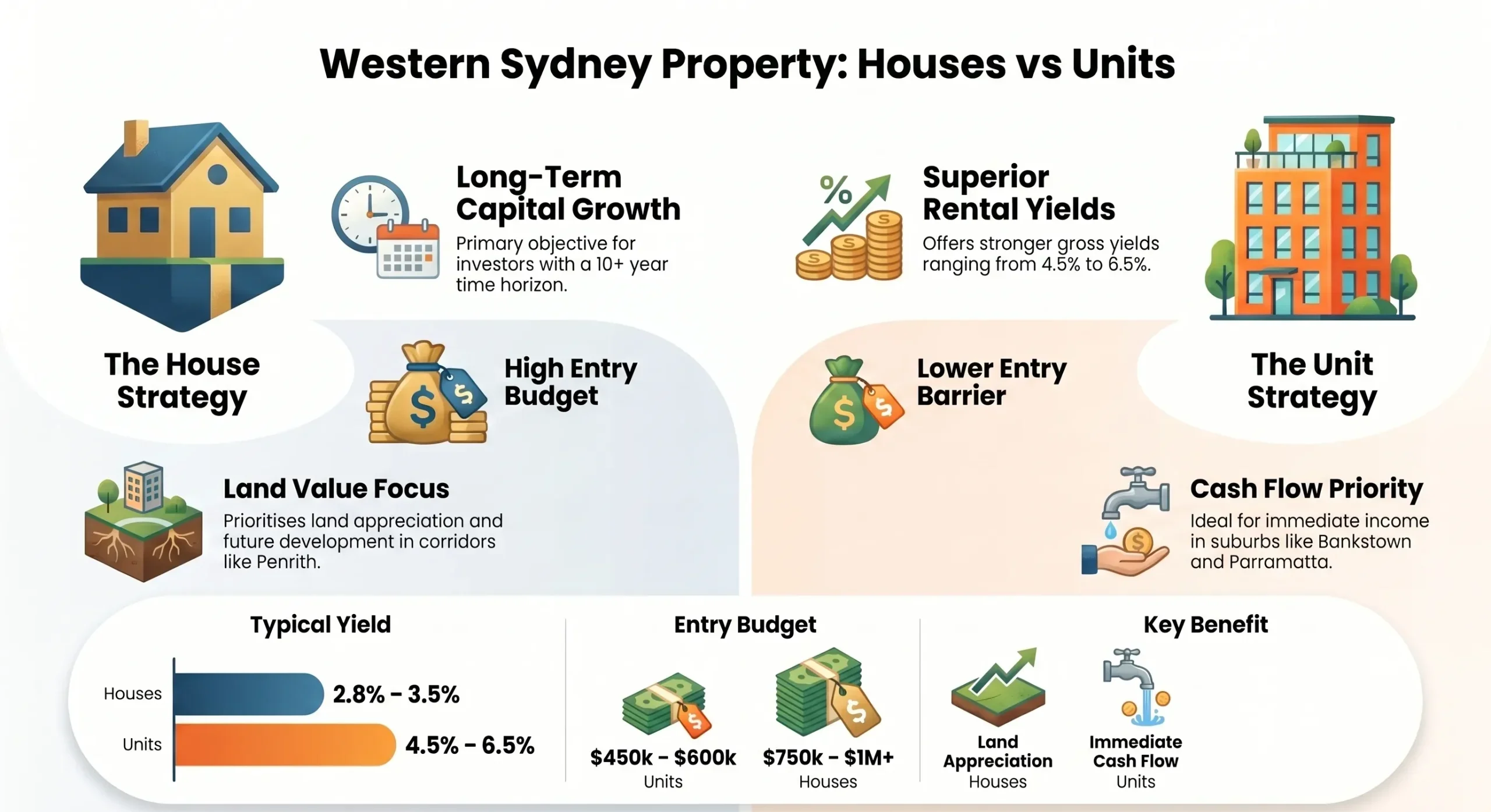
The decision between houses and units in Western Sydney comes down to your investment objectives.
Choose houses if:
- Capital growth over 10+ years is your primary objective
- You have a higher entry budget ($750,000 to $1,000,000+)
- You are comfortable with lower initial yields (2.8% to 3.5%)
- You want the optionality of future development or renovation
- Your focus is on land value appreciation in growth corridors like Penrith and Jordan Springs
Choose units if:
- Yield and cash flow in the near term is your priority
- Your entry budget is $450,000 to $600,000
- You want stronger gross yields (4.5% to 6.5%)
- You prefer lower maintenance responsibility
- You are targeting a diverse, stable tenant pool in middle-ring suburbs like Auburn, Granville, or Blacktown
High-yield suburbs like Bankstown, Parramatta, and Liverpool are better for immediate income — renters are typically workers and families, with lower capital growth but better annual cash flow. The Sydney-wide average house yield sits around 2.6%. Houses in any Sydney submarket struggle to clear 3.5% once inside the metro. Units are where the yield story sits.
Tax and Depreciation: Boosting Your After-Tax Return
Rental yield calculations rarely account for tax benefits — which can meaningfully improve your after-tax return, particularly on newer properties.
Negative Gearing
If your property expenses exceed rental income, the shortfall is tax-deductible against other income. On a Western Sydney property yielding 3.5% gross with a 6.0% interest rate, the negative gearing benefit reduces the effective holding cost for investors on higher marginal tax rates.
Depreciation
New or near-new properties qualify for depreciation deductions on both the building structure (Division 43) and plant and equipment (Division 40). On a new unit in Penrith or Blacktown, depreciation deductions of $8,000 to $15,000 per year in the first five years are common — significantly improving after-tax cash flow.
A quantity surveyor’s depreciation schedule costs $500 to $700 and typically delivers many times that amount in annual tax savings. For any Western Sydney investment property built after 1985, a depreciation schedule is essential.
Always confirm tax strategy with your accountant — individual circumstances vary significantly.
Get a Free Rental Appraisal Before You Invest
If you are evaluating an investment property in Western Sydney, a current rental appraisal from a local specialist is your most important pre-purchase data point. The difference between an accurate rental appraisal and an aspirational estimate can be $30 to $80 per week — which translates to thousands of dollars in annual yield miscalculation.
Real Homes Realty provides free rental appraisals for investment properties across Western Sydney — including Penrith, Blacktown, Parramatta, Kellyville, Jordan Springs, Auburn, Granville, and Merrylands. Our appraisals are based on current market data from recently leased comparable properties, not estimates or industry averages.
👉 Request a free rental appraisal today 👉 Contact our Western Sydney property management team
Related Reading
- The Complete Guide to Property Management in Western Sydney (2026)
- Property Management Fees in Western Sydney: What’s Fair in 2026?
- How to Find Quality Tenants in Penrith and Blacktown
External Resources
- SQM Research — Vacancy Rates by Suburb
- ATO — Rental Property Tax Deductions
- NSW Fair Trading — Investment Property Guide