
Written by the Real Homes Realty Property Management Team | Last updated: May 2026
Landlord rights and responsibilities NSW laws changed more significantly between 2024 and 2026 than in any period in recent memory. The Residential Tenancies Amendment Act 2024 — rolled out in three stages between October 2024 and March 2026 — reshaped what landlords can and cannot do across every aspect of a tenancy.
For Western Sydney property owners in particular, staying across these changes is not optional. Failure to adhere to the new rules could lead to penalties, disputes, or fines. Landlords must carefully follow procedures when increasing rent, terminating leases, or responding to pet requests.
This guide covers every major right and responsibility under NSW law as it stands in 2026 — written specifically for landlords managing properties in Penrith, Blacktown, Parramatta, Kellyville, Jordan Springs, and surrounding Western Sydney suburbs.
For a broader overview of property management across the region, read our Complete Guide to Property Management in Western Sydney (2026).
- The 2025–2026 NSW Rental Law Changes: What Happened and When
- Landlord Rights and Responsibilities NSW: What Every Western Sydney Landlord Must Know
- Your Rights as a NSW Landlord
- Your Responsibilities as a NSW Landlord in 2026
- Ending a Tenancy: The New Rules in Full
- Handling Repairs and Maintenance
- NCAT: Your Dispute Resolution Pathway
- Compliance Checklist for Western Sydney Landlords (2026)
- Need Help Staying Compliant in Western Sydney?
The 2025–2026 NSW Rental Law Changes: What Happened and When
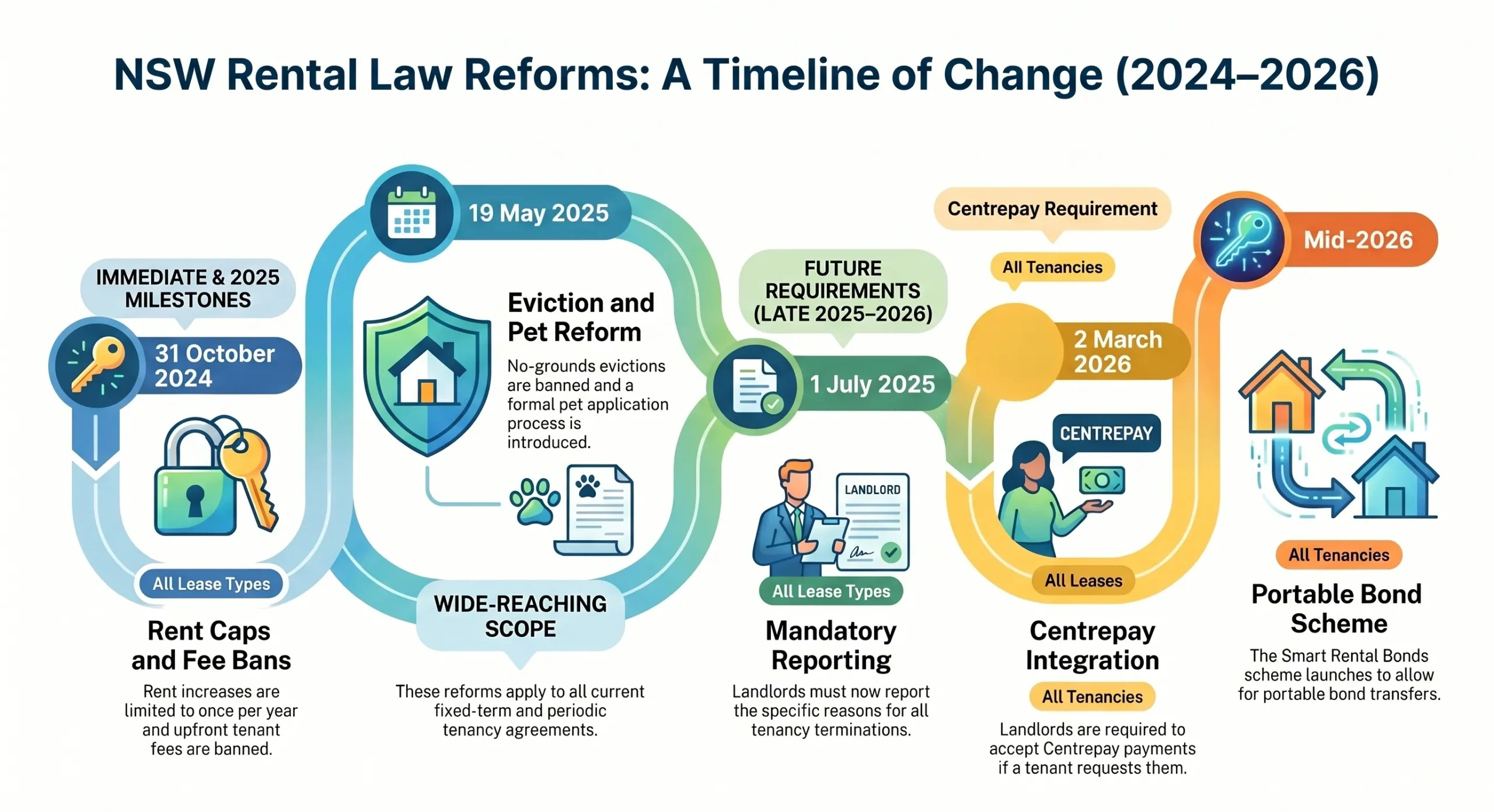
The NSW tenancy law changes started in stages. The rent increase cap and fee bans started on 31 October 2024, the no-grounds eviction ban and pet rule changes started on 19 May 2025, and the Centrepay requirement started on 2 March 2026.
The main reforms apply to all residential tenancy agreements, including existing fixed-term and periodic agreements. This means current tenancies are affected, not just new leases signed after the law changes began.
| Change | Effective Date | Applies To |
|---|---|---|
| Rent increases capped to once per year | 31 October 2024 | All lease types |
| Upfront tenant fees banned | 31 October 2024 | All new tenancies |
| No-grounds evictions banned | 19 May 2025 | All leases |
| Pet application process introduced | 19 May 2025 | All leases |
| Fee-free rent payment required | 19 May 2025 | All tenancies |
| Mandatory tenancy end reason reporting | 1 July 2025 | All terminations |
| Centrepay payment required if requested | 2 March 2026 | All tenancies |
| Smart Rental Bonds portable scheme | Mid-2026 | All new bonds |
Landlord Rights and Responsibilities NSW: What Every Western Sydney Landlord Must Know
Your Rights as a NSW Landlord
Before covering your obligations, it is important to understand what you are entitled to as a landlord. These rights are protected under the Residential Tenancies Act 2010 (NSW) and remain in force despite the 2025 reforms.
The Right to Receive Rent on Time
You are entitled to receive rent on the day specified in the tenancy agreement. If rent falls into arrears, you have a clear legal process available: a written breach notice on day 14 of arrears, followed by a termination notice if unpaid, and an NCAT application for possession if the breach is not remedied.
The Right to Your Property Back in Good Condition
At the end of a tenancy, you are entitled to have your property returned in the same condition as when the tenant moved in, allowing for fair wear and tear. You can make a bond claim for damage beyond fair wear and tear, unpaid rent, or cleaning costs where the property was not left in an appropriate state.
The Right to Conduct Routine Inspections
You are entitled to conduct up to four routine inspections per year — with proper notice. This allows you to monitor the property’s condition, identify maintenance issues early, and ensure the tenancy agreement is being complied with.
The Right to End a Tenancy for Valid Reasons
While no-grounds evictions are now unlawful, you retain the right to end a tenancy for a range of legitimate reasons. Valid reasons include: the tenant is at fault because of a breach of lease, damage to the property, or non-payment of rent; the property is being sold or offered for sale with vacant possession; the property needs to be empty for significant repairs or renovations, or the property will be demolished; the property will no longer be used as a rental home; the landlord or their family intend to move into the property; or the tenant lives in the property as part of their employment and their employment has ended.
The Right to Increase Rent
You retain the right to increase rent — subject to the once-per-12-months cap and minimum notice requirements. There is no cap on the amount of increase in NSW, though tenants can challenge excessive increases at NCAT.
Your Responsibilities as a NSW Landlord in 2026
1. Providing and Maintaining a Habitable Property
Your most fundamental obligation as a landlord is to provide a rental property that is safe, secure, reasonably clean, and fit to live in throughout the tenancy — not just at the start.
This includes maintaining:
- Structural integrity of the building
- All locks and security devices in working order
- All essential services: hot water, heating, cooling if provided, stove/oven
- Plumbing, electrical systems, and gas in safe working order
- All inclusions listed in the tenancy agreement
Water efficiency compliance (from March 2025): From 23 March 2025, all toilets in rentals must be dual flush, with a minimum 3-star Water Efficiency Labelling and Standards (WELS) rating, to meet legally prescribed water efficiency measures. If the landlord does not meet the water efficiency standards, they cannot pass on water usage charges to the tenant.
2. Conducting a Proper Entry Condition Report
At the start of every new tenancy, you must provide the tenant with a completed entry condition report and allow them time to review, sign, and return it with any disagreements noted. This document is critical — it is the benchmark against which the property’s condition at the end of the tenancy is measured.
A thorough entry condition report with detailed photographs taken on the day of handover is your most important legal protection against bond disputes. Gaps in this document almost always resolve in the tenant’s favour at NCAT.
3. Lodging the Bond Correctly
You must lodge the bond with NSW Fair Trading’s Rental Bonds Online within 10 business days of receiving it. The maximum bond is four weeks’ rent. Failure to lodge the bond correctly is a compliance breach and can result in a penalty notice from NSW Fair Trading.
The NSW government’s portable bonds scheme, ‘Smart Rental Bonds’, is set to start in mid-2026. The scheme allows tenants to transfer their bond directly between tenancies for a $25 fee.
4. Giving Correct Notice Before Entry
You must give the tenant proper written notice before entering the property for any reason — except in genuine emergencies.
| Reason for Entry | Minimum Notice Required |
|---|---|
| Routine inspection | 7 days written notice |
| Non-urgent repairs or maintenance | 2 days notice |
| Showing the property to prospective buyers | 1 hour notice (if agreement in place) |
| Genuine emergency | No notice required |
Entering the property without proper notice is a breach of the tenant’s right to quiet enjoyment and can result in a complaint to NSW Fair Trading and a Tribunal order.
5. Managing Rent Increases Correctly
Rent increases are now limited to once every 12 months — regardless of whether a tenant is on a fixed or periodic lease. Previously, the once-per-12-months cap only applied to periodic leases or fixed-term leases over two years. The 2024 reforms extended it to all lease types.
Notice requirement: You must give at least 60 days’ written notice before any rent increase takes effect. The notice must be in writing and specify the new amount and the date from which it applies.
No increase permitted in the first 12 months: You cannot increase rent within the first 12 months of a new tenancy agreement.
Cannot increase for pets: Note that an increase in bond or rent will not be a reasonable condition for granting permission to keep a pet. Charging more rent or a higher bond because of a pet is unlawful.
6. Processing Pet Applications Within 21 Days
From 19 May 2025, there is now a structured process with clear rules on when the landlord can refuse permission or when the landlord can impose conditions with the permission.
Pet requests must receive a written response within 21 days. If no response is given, the pet is automatically approved. Approvals cannot be revoked while the pet lives on the premises. Acceptable reasons for refusal are now narrowly defined.
Valid reasons to refuse a pet application:
- The property has inadequate fencing or space for the animal
- Keeping the animal would breach strata by-laws or local council rules
- The landlord lives at the property
- The animal would be a health risk or danger to others
- The type of animal is prohibited by law
The landlord/agent cannot refuse a request without a valid reason, or impose unreasonable conditions that make it impossible to keep a pet. NSW Fair Trading will have a much more active role in mediating disputes about pets and NCAT will have the final word.
Practical implication for Western Sydney landlords: If you receive a pet application, set a calendar reminder for day 20. A missed deadline means automatic approval — regardless of the circumstances.
7. Offering Fee-Free Rent Payment Options
From 19 May 2025, you must offer at least one fee-free electronic payment method for rent — such as direct bank transfer. You cannot require tenants to use a specific third-party app that charges transaction fees.
From 2 March 2026, landlords and agents are required to offer payment by Centrepay and enable payment by this method if the tenant chooses it. Centrepay is a free voluntary service run by Services Australia that allows rent to be deducted directly from a Centrelink payment.
8. Banning Upfront Tenant Fees
From 31 October 2024, landlords and agents can no longer charge tenants for background checks or tenancy agreement preparation fees. These extra upfront costs were banned as part of the rental reforms. If your agency is still charging these, they are breaching the Act.
9. Reporting Tenancy End Reasons
From 1 July 2025, NSW Fair Trading started collecting information about reasons a tenancy has ended through Rental Bonds Online. The mandatory survey helps NSW Fair Trading understand how and why tenancies are ending. Landlords and agents have 14 days from the initial bond claim to complete the survey. NSW Fair Trading can serve a penalty notice for non-compliance.
This is a compliance step many Western Sydney landlords are unaware of. Make sure your property manager is completing this survey on your behalf.
10. Pre-Tenancy Disclosure Obligations
Before signing a new tenancy agreement, you must disclose to the prospective tenant:
- Any flooding or fire damage to the property in the past five years
- Any major crime that occurred at the property
- Any easement on the property that allows third-party access
- Whether an order has been made requiring rectification of defects
Failure to disclose material information can give the tenant grounds to terminate the tenancy without penalty.
Ending a Tenancy: The New Rules in Full
This is the area where the 2025 reforms have the most practical impact on Western Sydney landlords.
No-Grounds Evictions Are Now Unlawful
Before 19 May 2025, NSW landlords could end a tenancy for any reason or no reason at all, as long as they provided the required notice period. This is no longer the case. Every termination notice must state a valid, legally recognised reason — and that reason must be genuine.
Since 1 July 2025, the landlord/agent is required to report the reason for the tenancy ending after the bond is claimed. The reason can then be checked and significant penalties applied if it is not genuine.
Notice Periods by Situation
| Situation | Minimum Notice |
|---|---|
| Periodic tenancy — valid landlord reason | 90 days |
| Fixed-term lease over 6 months — valid reason | 90 days |
| Fixed-term lease 6 months or less — valid reason | 60 days |
| Sale requiring vacant possession (contract signed) | 30 days (fixed term must have ended) |
| Tenant breach — non-payment of rent | 14 days |
| Tenant breach — other serious breach | 14 days |
What Happens If a Tenant Disputes the Reason
If you want to dispute the reason given for eviction as not genuine, the tenant has the right to challenge the validity of the termination notice at the Tribunal. They can do this when they receive the notice, or when the landlord applies to the Tribunal for an eviction order. The time-limit to apply to the Tribunal is 90 days from receipt of the notice.
The practical implication: keep detailed written records supporting any termination decision. Verbal conversations are not evidence at NCAT.
Handling Repairs and Maintenance
Urgent Repairs
You must respond to urgent repairs immediately. Under NSW law, urgent repairs include:
- Burst water pipes or serious water leaks
- Gas leaks
- Dangerous electrical faults or power failures
- Broken locks or security devices
- Storm or flood damage
- Failure of essential services: hot water, heating, cooling if provided
If you fail to address an urgent repair, the tenant has the right to arrange the repair themselves (up to a prescribed limit) and deduct the cost from rent.
Non-Urgent Repairs
Acknowledge non-urgent maintenance requests within 48 hours. Resolve them within a reasonable timeframe — typically 14 business days for non-critical issues. Document all requests and responses in writing.
What “Fair Wear and Tear” Means
Fair wear and tear is the natural deterioration of a property through normal, everyday use. You cannot claim bond money for fair wear and tear. The distinction matters:
| Fair Wear and Tear (not claimable) | Damage (claimable) |
|---|---|
| Faded paintwork after several years | Large holes in walls |
| Worn carpet in high-traffic areas | Burns or stains in carpet |
| Minor scuffs on walls | Broken windows or doors |
| Loose door handles from regular use | Unapproved modifications |
NCAT: Your Dispute Resolution Pathway
The NSW Civil and Administrative Tribunal is the designated body for resolving residential tenancy disputes. It is accessible, low cost, and its orders are legally enforceable.
When to Apply to NCAT
- Tenant has not paid rent and breach notice has not been remedied
- Bond claim is disputed by the tenant
- Tenant is refusing inspection access
- Tenant has caused damage beyond fair wear and tear
- You need to challenge a tenant’s NCAT application against you
The NCAT Process
- Lodge an application online at ncat.nsw.gov.au (filing fees apply)
- Both parties receive a hearing date — typically 2 to 4 weeks from lodgement for urgent matters
- Hearing is conducted by a NCAT Member — attendance is required
- Orders are made on the day or within a short period
- Orders are legally enforceable — non-compliance can result in further legal action
A property manager experienced in Western Sydney NCAT matters — particularly the Penrith and Parramatta registries — will handle this process on your behalf efficiently and with the right documentation.
Compliance Checklist for Western Sydney Landlords (2026)
This landlord rights and responsibilities NSW checklist will help ensure your tenancy processes remain compliant in 2026:
- All rent increases limited to once per 12 months with 60 days written notice
- No upfront fees charged to prospective tenants
- At least one fee-free electronic rent payment method offered
- Centrepay offered as a payment option if requested by tenant
- All termination notices include a valid, documented reason
- Bond lodged with Rental Bonds Online within 10 business days
- Entry condition report completed thoroughly at tenancy start
- Routine inspections conducted with minimum 7 days written notice
- Pet applications responded to within 21 days
- Tenancy end reason reported via Rental Bonds Online within 14 days of bond claim
- All toilets in the property are dual flush with minimum 3-star WELS rating
Need Help Staying Compliant in Western Sydney?
NSW tenancy law is more complex in 2026 than at any point in the past decade. For Western Sydney landlords managing properties in Penrith, Blacktown, Parramatta, Kellyville, Jordan Springs, Schofields, and surrounding suburbs, the compliance burden is real — and the consequences of getting it wrong are significant.
Real Homes Realty’s property management team stays current with every change to NSW tenancy law and manages compliance on behalf of our landlords as a standard part of our service. You do not need to be a tenancy law expert — you need a property manager who is.
👉 Get a free rental appraisal for your Western Sydney property 👉 Contact our property management team today
Related Reading
- The Complete Guide to Property Management in Western Sydney (2026)
- How to Choose a Property Manager in Western Sydney
- Property Management Fees in Western Sydney: What’s Fair in 2026?
- How to Handle Tenant Disputes in Western Sydney
External Resources
- NSW Government — Changes to Rental Laws
- NSW Fair Trading — Landlord Rights and Responsibilities
- NCAT — Residential Tenancy Applications
- Rental Bonds Online — Lodge and Track Your Bond