

Written by the Real Homes Realty Property Management Team | Last updated: May 2026
Tenant disputes Western Sydney landlords face are more common than most property investors expect — and far more manageable than they fear. Most tenancy disputes in NSW are resolved before reaching NCAT, provided landlords follow the correct documentation and dispute resolution process.
This guide covers every major type of tenant dispute a Western Sydney landlord is likely to encounter: rent arrears, property damage, bond claims, unauthorised pets, illegal modifications, and tenants who refuse access. For each dispute type, we provide the exact process — what to do first, when to escalate, how to document, and how to use NCAT if necessary.
Understanding tenant disputes Western Sydney property owners experience can help landlords avoid expensive legal mistakes and prolonged vacancies.
For a broader overview of property management across Western Sydney, read our Complete Guide to Property Management in Western Sydney (2026).
- The Golden Rule: Everything in Writing, From Day One
- The Dispute Resolution Pathway in NSW
- Dispute Type 1: Rent Arrears
- Dispute Type 2: Property Damage
- Dispute Type 3: Bond Disputes at NCAT
- Dispute Type 4: Unauthorised Pets
- Dispute Type 5: Unauthorised Modifications
- Dispute Type 6: Tenant Refusing Inspection Access
- Dispute Type 7: Invalid Termination Notice
- How to Apply to NCAT: Step by Step
- Orders NCAT Can Make in Favour of Landlords
- Time Limits: Do Not Miss These
- When to Use a Property Manager for Dispute Management
- Let Real Homes Realty Manage Your Disputes
The Golden Rule: Everything in Writing, From Day One
Before covering specific dispute types, the most important principle in NSW tenancy dispute management applies to all of them:
everything must be in writing, from the first day something goes wrong.
NCAT makes decisions based on clear and documented evidence. The Tribunal will make a decision by applying the law to evidence — such as photos, written details, copies of emails, and other documents. Verbal conversations, no matter how clear you remember them, are not evidence at NCAT. A text message is. An email is. A signed notice is.
From the first time a rent payment is late, a maintenance issue is identified, or a lease concern is raised — write it down, send it in writing, and keep a copy. This habit is the single most valuable thing a Western Sydney landlord can do to protect their position in any future dispute.
The Dispute Resolution Pathway in NSW
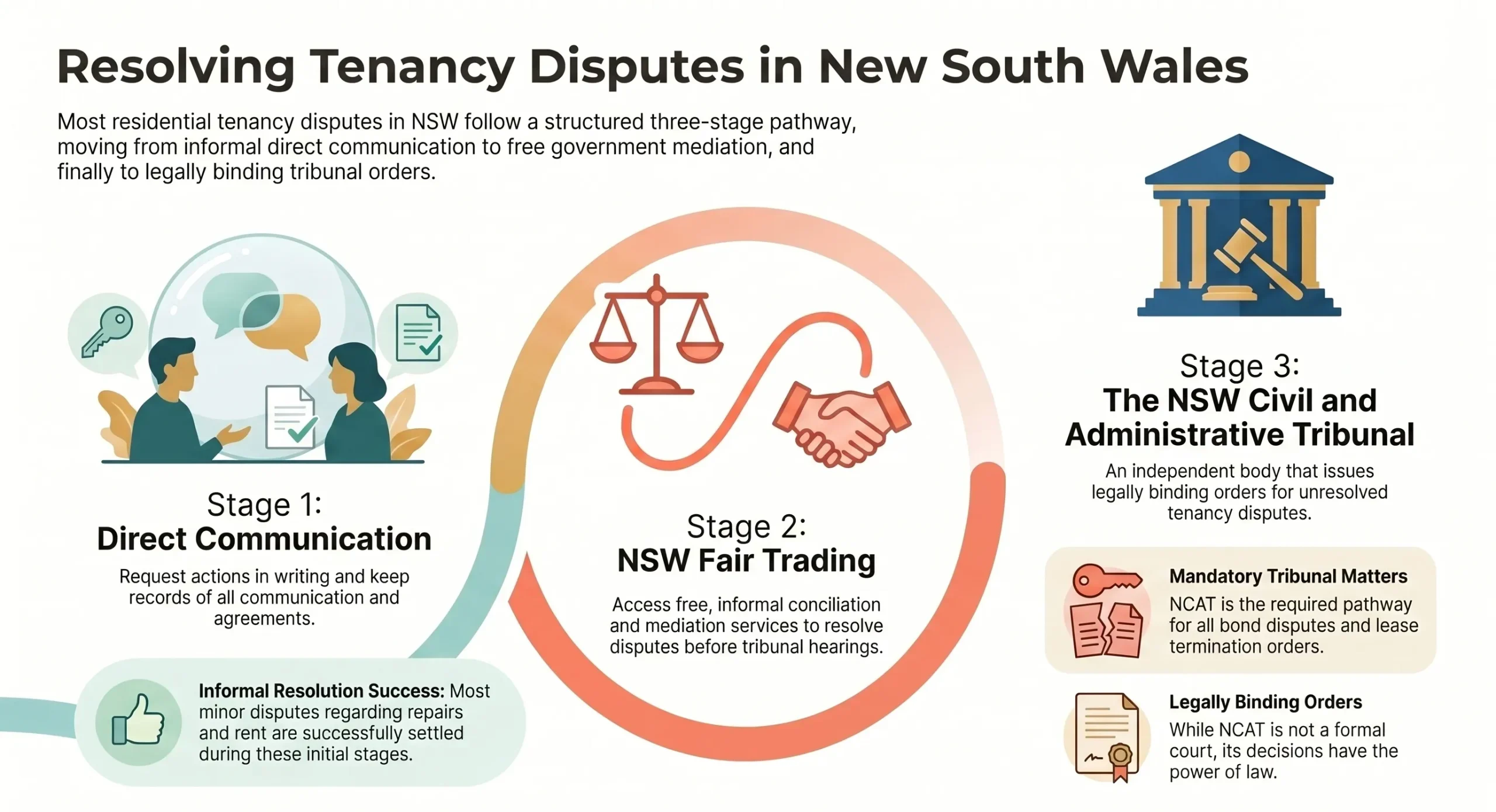
Most disputes in NSW follow a three-stage pathway. Understanding this pathway before a dispute arises helps you move through it efficiently and with the right documentation at each stage.
Stage 1 — Direct Communication
It is best for the tenant and landlord or agent to try to resolve any issues between themselves. To help reduce further disputes and keep records and evidence if needed, tenants should make requests in writing, including the details of any agreement reached.
In practice: contact the tenant in writing, state the issue clearly, request a specific action by a specific date, and keep a copy. Most minor disputes — a missed rent payment, a minor lease breach, a maintenance disagreement — are resolved at this stage.
Stage 2 — NSW Fair Trading
If an agreement cannot be reached, tenants, landlords and agents have several options to resolve a dispute. NSW Fair Trading offers a free tenancy complaint and conciliation service. Either party can lodge a complaint and Fair Trading will attempt to mediate a resolution.
Fair Trading conciliation is faster and less formal than NCAT. Many disputes about repairs, damage, bond claims, and pet applications are resolved through this process without proceeding to a tribunal hearing. Before going to NCAT, it is a good idea to have written to the landlord and tried to negotiate before taking an issue to the Tribunal. You can also make a complaint to the free NSW Fair Trading complaint service.
Stage 3 — NCAT
The NSW Civil and Administrative Tribunal (NCAT) is an independent body that has the power to decide disputes between landlords and tenants in residential tenancies. The Tribunal can make orders about bonds, evictions, repairs, pets, and other aspects of tenancy. NCAT is not a formal court, but its decisions are legally binding.
A landlord or tenant can apply directly to the Tribunal for orders relating to a residential tenancy instead of first making a complaint to Fair Trading, if they wish. For termination orders and bond disputes, NCAT is the required pathway.
The Dispute Resolution Pathway at a Glance
| Stage | Who | When | Cost |
|---|---|---|---|
| Direct communication | Landlord/tenant | Always first | Free |
| NSW Fair Trading conciliation | Either party | When direct fails | Free |
| NCAT application | Either party | When Fair Trading fails or for serious matters | Application fee applies |
Dispute Type 1: Rent Arrears
Rent arrears is the most common tenant dispute in Western Sydney — and the one where the speed of your response matters most. Every week of inaction is a week of lost rent that becomes harder to recover.
The Correct Arrears Process
Day 1 of arrears: Send a written reminder — email or text. Keep it factual and non-confrontational. Document the date sent and the outstanding amount.
Day 7: If rent remains unpaid, send a formal written notice of arrears. State the amount outstanding, the date it was due, and request payment within a specific timeframe.
Day 14: Issue a formal Notice to Remedy Breach under the Residential Tenancies Act 2010 (NSW). This is the legal document that triggers the formal process. It must state the nature of the breach (non-payment of rent), the amount outstanding, and give the tenant 14 days to remedy the breach.
Day 28 (if unpaid): Issue a Notice of Termination — giving the tenant notice that the tenancy will end if the breach is not remedied.
NCAT application: If the tenant does not pay the outstanding rent and does not vacate, apply to NCAT for a termination and possession order. Applications for breach of a residential tenancy agreement must be made within three months after the person became aware of the breach.
Critical Rule: Never Stop Collecting Rent
Continue to accept any partial rent payments during the arrears process. Refusing to accept partial payment can complicate your legal position. Record every payment received and every amount outstanding.
What NCAT Can Order for Rent Arrears
- A payment order requiring the tenant to pay outstanding rent
- A termination and possession order if the breach is not remedied
- A money order for the amount outstanding including any costs
The Cost of Inaction
On a $510/week Penrith house, 8 weeks of partial or zero rent while an unprofessional arrears process drags on costs $4,080 in lost income — plus potential NCAT costs. A property manager with a clear, consistent arrears process is the most effective protection against this scenario.
Dispute Type 2: Property Damage
Property damage disputes arise at the end of a tenancy when a landlord believes the property has been damaged beyond fair wear and tear and the tenant disputes the bond deduction.
Prevention: The Entry Condition Report
The most important document in any damage dispute is one you create before the tenancy begins — the entry condition report. A detailed rental inspection checklist with documented proof of the property’s condition at move-in is your best defence against unfair deductions at move-out. Without a clear rental inspection checklist record, a landlord could attempt to charge for pre-existing damage.
The same principle applies in reverse: without a thorough, photographic entry condition report, you cannot prove that damage identified at the end of the tenancy was caused by the current tenant rather than being pre-existing.
Identifying Damage During the Tenancy
Damage identified during a routine inspection should be documented immediately with timestamped photographs and addressed through a formal breach notice — not left until the end of the tenancy. A series of inspection reports showing the damage was not present at move-in and appeared during the current tenancy is far stronger evidence at NCAT than an end-of-tenancy claim with no prior documentation.
The Bond Claim Process
When a tenancy ends and damage has been identified:
Step 1: Conduct a thorough exit condition inspection on or immediately after the day the tenant vacates. Photograph everything systematically.
Step 2: Compare the exit condition against the entry condition report. Document every discrepancy.
Step 3: Obtain tradesperson quotes for all required rectification work.
Step 4: Lodge a bond claim through NSW Fair Trading’s Rental Bonds Online, specifying the amount claimed and the reason.
Step 5: If the tenant disputes the bond claim, the matter proceeds to NCAT for a bond hearing.
Fair Wear and Tear vs Damage
Understanding this distinction is essential. You cannot claim bond for fair wear and tear — only for damage beyond normal use.
| Fair Wear and Tear | Damage |
|---|---|
| Faded paint after several years | Large holes in walls |
| Worn carpet in hallways | Burns or stains in carpet |
| Minor scuffs at furniture height | Broken windows or fixtures |
| Loose door handles from use | Unapproved modifications |
| Small nail holes | Excessive mould from negligence |
Dispute Type 3: Bond Disputes at NCAT
Bond disputes are among the most common matters heard at NCAT in Western Sydney. The process is designed to be accessible — most people represent themselves — but the outcome almost always turns on the quality of documentation.
What NCAT Needs to Decide a Bond Dispute
- Entry condition report with photographs
- Exit condition report with photographs
- Inspection reports from during the tenancy
- Tradesperson invoices or quotes for rectification work
- The tenancy agreement
- Any written communications about the damage or condition
NCAT makes decisions based on clear and documented evidence. At Brand Property, we’ve seen numerous cases where one recent case took six hours to prepare all the necessary documentation for repairs and cleaning costs, but it was well worth the time. A well-prepared case ensures that NCAT has all the facts it needs to make an informed decision.
Time Limits
An application to the Tribunal must be lodged within a certain time limit. For most disputes you must apply within 28 days. This time limit starts from the day you become entitled to apply — this will usually be the day when the issue first happens.
For bond claims specifically, a claim can be submitted once the tenancy has ended and the bond status is “HELD” in Rental Bonds Online.
Dispute Type 4: Unauthorised Pets
From 19 May 2025, pet applications in NSW follow a structured process — but disputes still arise when a tenant keeps a pet without submitting an application, or when a landlord refuses an application for reasons that are not legally valid.
Tenant Has a Pet Without Applying
If you discover during a routine inspection that the tenant has a pet that was not approved:
Step 1: Document the pet’s presence with photographs.
Step 2: Issue a written breach notice. The tenant has 14 days to remedy — which may mean applying through the proper pet application process or removing the pet.
Step 3: If the tenant submits a pet application at this stage, you must still process it through the formal 21-day response process. You cannot refuse it solely because it was not submitted before the pet arrived.
Step 4: If the tenant neither applies nor removes the pet within the notice period, apply to NCAT.
Landlord Refuses Pet Application Without Valid Reason
Landlords and agents cannot state in an advertisement that no pets are allowed at a rental property. If a landlord refuses a pet for a reason that is not applicable or a tenant believes the landlord has set an unreasonable condition for consent, they should first try and talk to their landlord or agent to resolve the dispute. If the issue cannot be resolved, the tenant can apply to the Tribunal to challenge the reason for the refusal or the unreasonable condition.
Valid refusal reasons under the 2025 reforms are limited — inadequate fencing, strata by-law restrictions, landlord living on premises, and a small number of others. General dislike of animals is not valid.
Dispute Type 5: Unauthorised Modifications
Tenants are not permitted to make modifications to a rental property without written consent. Common unauthorised modifications in Western Sydney rentals include painting walls, installing shelving, adding curtain rods, and more significant structural changes.
The Process
Step 1: Document the modification with timestamped photographs during a routine inspection.
Step 2: Issue a written breach notice requiring the tenant to restore the property to its original condition within 14 days — or to seek retrospective written approval if the modification is acceptable.
Step 3: If the modification is acceptable (minor and reversible), consider providing written consent with conditions — for example, requiring the tenant to return the walls to the original paint colour at the end of the tenancy.
Step 4: If the modification is significant and the tenant does not remedy within the notice period, apply to NCAT.
Dispute Type 6: Tenant Refusing Inspection Access
If a tenant unreasonably refuses entry after proper notice has been given, the landlord has the right to apply to NCAT for an order permitting access.
Before Applying to NCAT
Confirm that your notice was legally correct — 7 days written notice, within permitted hours, not on a Sunday or public holiday. If there was any deficiency in the notice, the tenant’s refusal may not be unreasonable.
Consider whether the tenant has a legitimate reason for the timing — a newborn, a night-shift worker, a medical appointment. Offering a reasonable alternative time is good practice and avoids unnecessary escalation.
If the Refusal Is Unreasonable
Document the refusal in writing — note the date and time of the attempted inspection and the tenant’s response. Write to the tenant confirming the refusal and stating that you will apply to NCAT for an access order if the matter is not resolved. Apply to NCAT if the tenant continues to refuse.
Dispute Type 7: Invalid Termination Notice
Since 19 May 2025, no-grounds evictions are unlawful in NSW. Tenants now have the right to challenge a termination notice if the reason given is not valid or not genuine.
As a landlord, every termination notice you issue must state a valid, documented reason — and that reason must be genuine. Since 1 July 2025, the landlord/agent is required to report the reason for the tenancy ending after the bond is claimed. The reason can then be checked and significant penalties applied if it is not genuine.
Tenants or landlords may dispute a termination notice if the notice was not given correctly, the reason for the notice was not genuine, or (for tenants) if the landlord has given false or misleading supporting documents.
If a tenant challenges your termination notice at NCAT, you need documented evidence supporting your stated reason. Keep all relevant records — contracts of sale, development approvals, statutory declarations from family members — depending on the grounds for termination.
How to Apply to NCAT: Step by Step

You can apply to NCAT to make certain decisions, review decisions or resolve a dispute. NCAT deals with a wide range of everyday issues and disputes.
The Application Process
Step 1 — Gather your evidence. Assemble every piece of relevant documentation: the tenancy agreement, entry and exit condition reports with photographs, rent payment records, all written communications, inspection reports, and tradesperson invoices.
Step 2 — Complete the application. NCAT has an online application system for most tenancy matters. Applications typically take around 30 minutes to complete online. If online does not suit, a PDF application form can be downloaded from the NCAT website.
Step 3 — Pay the application fee. A standard application fee applies. A reduced concession fee is available for eligible persons.
Step 4 — Specify the orders you want. When you apply you need to specify the section of the Residential Tenancies Act 2010 and the orders you want NCAT to make. You can apply for more than one order.
Step 5 — Receive your notice of hearing. Receive your notice of hearing immediately online, or later by email or post.
Step 6 — Attend conciliation and hearing. Tenancy and social housing cases are first listed for conciliation and hearing. You and the other party will be asked to attempt resolution through conciliation first. If unresolved, the matter proceeds to a formal hearing before a Tribunal Member.
Common Mistakes That Weaken Your Case at NCAT
Based on tenant advocacy guidance, the most common mistakes are: using the wrong legal name for the landlord — “Agent X” or “Landlord” is not enough; NCAT needs the actual legal person or company; missing a time limit — applications for breach must be made within three months of becoming aware of the breach; not bringing enough evidence — printed copies, not just phone screenshots; not bringing copies for the other party — NCAT expects identical folders.
Orders NCAT Can Make in Favour of Landlords
NCAT can make orders in tenancy and social housing cases including:
| Order Type | When It Applies |
|---|---|
| Payment order | Unpaid rent or other money owed |
| Termination and possession order | Serious breach — rent arrears, damage, illegal activity |
| Compensation order | Costs incurred as a result of tenant’s breach |
| Repair or rectification order | Requiring the tenant to repair damage |
| Bond claim order | Determining how bond is to be distributed |
| Restraining order | Preventing tenant from specific conduct |
Time Limits: Do Not Miss These
Time limits are strictly enforced at NCAT. Missing a time limit can result in your application being dismissed or requiring a time extension application — which NCAT will not always agree to.
| Application Type | Time Limit |
|---|---|
| Breach of tenancy agreement | 3 months from becoming aware of breach |
| Bond dispute | Within 28 days of tenancy ending (generally) |
| Challenge to termination notice | 90 days from receiving the notice |
| Compensation claim | Confirm current limits at NCAT website |
When to Use a Property Manager for Dispute Management
Most Western Sydney landlords who self-manage handle routine tenancy matters competently. Disputes are where the value of professional property management becomes most apparent.
A property manager experienced in Western Sydney tenancy management brings three advantages in dispute situations:
Procedural knowledge. The correct notices, the correct timelines, the correct evidence — experienced managers follow the process correctly every time, reducing the risk of a technically flawed application that the tenant can challenge.
Emotional distance. Disputes with tenants can become personal and emotionally charged, particularly for landlords who have a direct relationship with their tenants. A property manager handles the matter as a professional procedure, reducing the risk of communication that could harm your legal position.
NCAT experience. A property manager who regularly appears at the Penrith and Parramatta NCAT registries understands what Tribunal Members look for, how conciliation typically unfolds, and how to present a case efficiently.
Let Real Homes Realty Manage Your Disputes
Navigating tenant disputes in Western Sydney requires the right process, the right documentation, and the right level of emotional distance. For landlords with investment properties in Penrith, Blacktown, Parramatta, Kellyville, Jordan Springs, and surrounding suburbs, Real Homes Realty’s property management team handles disputes professionally — from the first missed rent payment through to NCAT if necessary.
We follow a rigorous, documented process for every dispute type, maintain comprehensive records throughout each tenancy, and have direct experience at the Western Sydney NCAT registries.
👉 Get a free rental appraisal for your Western Sydney property 👉 Contact our property management team today
Related Reading
- The Complete Guide to Property Management in Western Sydney (2026)
- Landlord Rights and Responsibilities NSW 2026
- Routine Inspections NSW: What Every Western Sydney Landlord Must Know
- How to Find Quality Tenants in Penrith and Blacktown
External Resources
- NSW Government — Resolving Residential Tenancy Disputes
- NCAT — Tenancy and Social Housing
- NCAT — How to Apply
- NSW Fair Trading — Free Tenancy Complaint Service
- Tenants’ Union NSW — NCAT Guide