
Tenant rights NSW changed dramatically in 2025 — and if you rent in Western Sydney, these changes directly protect you. The Residential Tenancies Amendment Act 2024, which came into full effect on 19 May 2025, reshaped the rental landscape for millions of NSW tenants — banning no-grounds evictions, capping rent increases, strengthening pet rights, and eliminating unfair upfront fees. Your tenant rights NSW are now significantly stronger than at any point in the last decade.
This guide explains every major change, what it means for renters in suburbs like Penrith, Blacktown, Parramatta, Kellyville, and Jordan Springs, and how to protect yourself if your rights are not respected.
- What Changed? Overview of Tenant Rights NSW in 2025
- 1. No More “No-Grounds” Evictions — Your Security is Now Protected
- 2. Rent Increases — What Landlords Can and Cannot Do
- 3. Renting With a Pet in Western Sydney — Your New Rights
- 4. Bond — How Much, Where It Goes, and How to Get It Back
- 5. Rent Payment — Your Right to Fee-Free Options
- 6. Repairs and Maintenance — What Your Landlord Must Provide
- 7. Privacy and Quiet Enjoyment
- Where to Get Help — Dispute Resolution in Western Sydney
What Changed? Overview of Tenant Rights NSW in 2025
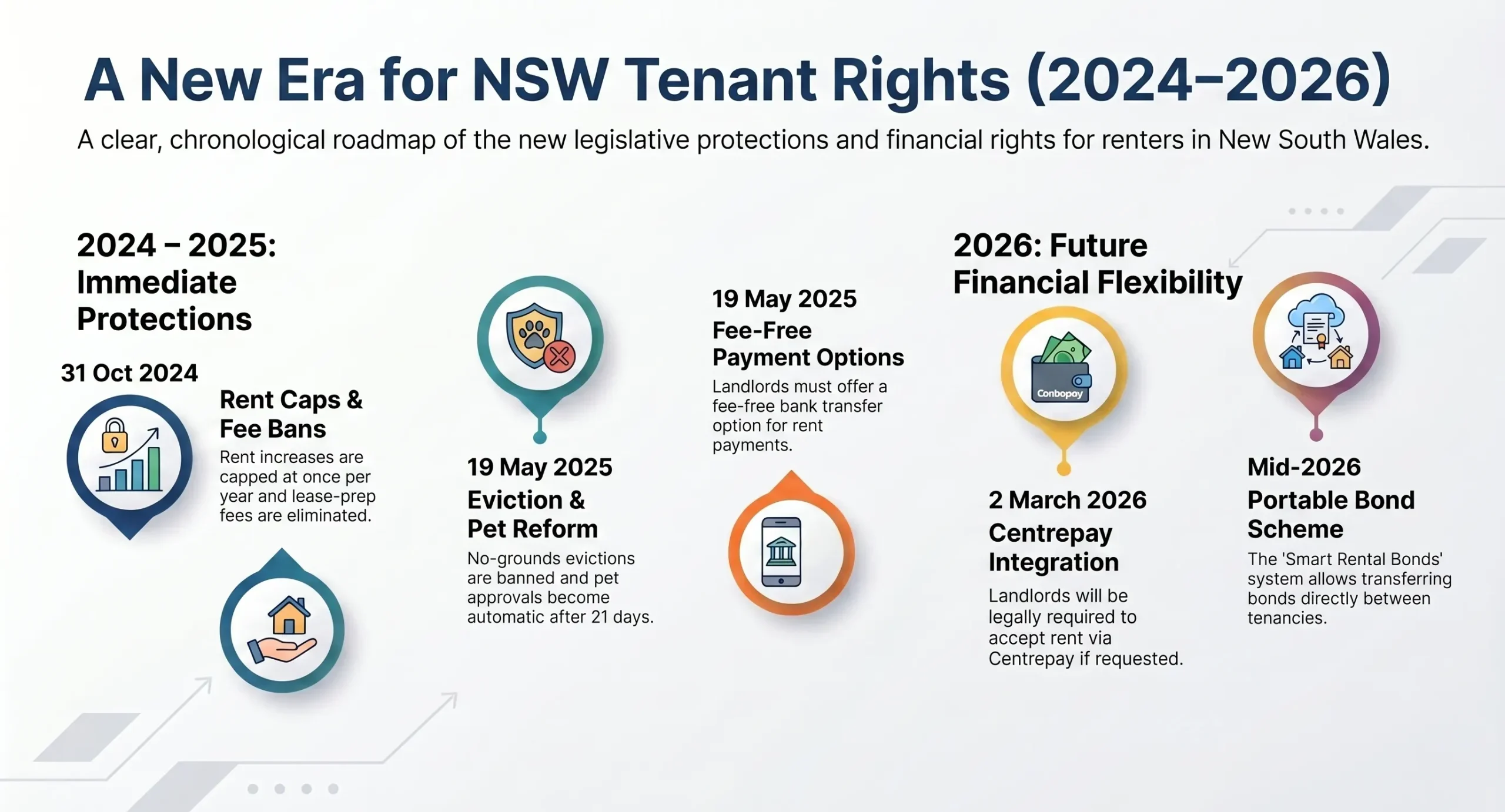
| Change | Effective Date | What It Means for You |
|---|---|---|
| No-grounds evictions banned | 19 May 2025 | Landlord must have a legal reason to end your lease |
| Rent increases capped to once per year | 31 Oct 2024 | Applies to all lease types including fixed-term |
| Pet rights strengthened | 19 May 2025 | Structured process, auto-approval if no response in 21 days |
| Upfront fees eliminated | 31 Oct 2024 | No fees for background checks or lease preparation |
| Fee-free rent payment required | 19 May 2025 | Bank transfer must be offered at no cost |
| Centrepay option added | 2 March 2026 | Landlords must accept Centrepay if tenant chooses it |
| Portable bond scheme (Smart Rental Bonds) | Mid-2026 | Transfer bond between tenancies without full repayment |
1. No More “No-Grounds” Evictions — Your Security is Now Protected
Before 19 May 2025, a landlord in NSW could end your lease without giving any reason — as long as they provided the required notice. This left millions of renters in housing insecurity.
Under the new laws, this is no longer legal. A landlord must now have a valid, legally recognised reason to end your tenancy — and must be able to prove it.
Valid Reasons a Landlord Can End Your Tenancy
- You have breached the tenancy agreement (e.g. non-payment of rent)
- The property requires significant renovations or demolition
- The property will no longer be used as a rental
- The landlord or an immediate family member will move in
- The property is being sold with vacant possession
- The tenancy is linked to an employment arrangement that has ended
New Minimum Notice Periods
| Lease Type | Minimum Notice (Non-Breach) |
|---|---|
| Periodic (ongoing) tenancy | 90 days |
| Fixed-term lease (over 6 months) | 90 days |
| Fixed-term lease (6 months or less) | 60 days |
| Non-payment of rent | 14 days |
2. Rent Increases — What Landlords Can and Cannot Do
From 31 October 2024, rent can only be increased once every 12 months. This applies to all residential tenancy agreements in NSW — including fixed-term leases of under two years, which were previously exempt.
- Your landlord must give you written notice of any rent increase
- Notice must be given at least 60 days before the increase takes effect
- No increase is permitted within the first 12 months of a new tenancy
- Landlords cannot charge higher rent or bond because you have a pet
3. Renting With a Pet in Western Sydney — Your New Rights
Keeping a pet in a rental property in Western Sydney is now significantly easier. Understanding your tenant rights NSW around pets can save you from unnecessary rejection.. From 19 May 2025, landlords can no longer blanket-ban pets in lease agreements or advertising.
How the New Pet Process Works
- Submit a written pet application to your landlord or property manager
- The landlord must respond in writing within 21 days
- If they do not respond within 21 days, the pet is automatically approved
- Consent, once given, applies for the life of the animal — even if the landlord or agent changes
Valid Reasons a Landlord Can Refuse
- The property has inadequate fencing or space for the animal
- Keeping the animal would breach strata by-laws or local council rules
- The landlord lives at the property
- The animal is likely to cause damage exceeding the bond amount
- The type of animal is prohibited by law
4. Bond — How Much, Where It Goes, and How to Get It Back
A rental bond in NSW cannot exceed four weeks’ rent. Your landlord or property manager is required to lodge your bond with NSW Fair Trading’s Rental Bonds Online system within 10 business days of receiving it.
Getting Your Bond Back
- If you leave the property in the condition it was in (allowing for fair wear and tear), you are entitled to a full bond refund
- Your landlord cannot require professional carpet cleaning unless you had a pet
- Always photograph the property thoroughly at both move-in and move-out
- You have 30 days after your tenancy ends to apply to NCAT for a bond dispute
5. Rent Payment — Your Right to Fee-Free Options
From 19 May 2025, your landlord or property manager must offer you at least one fee-free, electronic payment method — such as direct bank transfer. They cannot require you to use a specific third-party app that charges fees.
- Bank transfer must be offered at no cost to you
- From 2 March 2026, Centrepay must also be offered as an option if you request it
- No upfront fees can be charged for background checks or lease preparation
6. Repairs and Maintenance — What Your Landlord Must Provide
Your landlord is legally required to provide a rental property that is safe, secure, and reasonably clean. They must also maintain the property in a condition that meets minimum standards throughout your tenancy.
Tenant Responsibilities
- Minor maintenance: replacing light bulbs, general cleaning, garden upkeep
- Any significant repair should be requested in writing to your landlord
- Do not attempt major repairs yourself without written permission
- Continue paying rent even during a dispute — failure to pay can give the landlord grounds to end the tenancy
Landlord Disclosure Requirements
Before you sign a lease, your landlord must disclose if the property has been subject to flooding or fire in the past five years, has been the scene of a major crime, or has an easement accessible by others.
7. Privacy and Quiet Enjoyment
As a tenant in Western Sydney, you have the right to quiet enjoyment of your rental property. This means your landlord or property manager must give you adequate notice before entering for any reason.
- Routine inspections: at least 7 days written notice required
- Repairs or maintenance: at least 2 days notice in most cases
- Emergency situations: entry permitted without notice
Where to Get Help — Dispute Resolution in Western Sydney
Knowing your tenant rights NSW helps you choose the right channel for each type of dispute.
| Issue | Who to Contact |
|---|---|
| Unlawful eviction or invalid notice | NCAT — apply within 90 days |
| Bond dispute | NCAT — apply within 30 days of tenancy ending |
| Rent increase dispute | NSW Fair Trading, then NCAT |
| Pet application refused unreasonably | NSW Fair Trading mediation |
| Repairs not done | Contact landlord in writing, then NSW Fair Trading |
| General tenancy advice (free) | Tenants’ Union NSW — tenants.org.au |
NSW Fair Trading:
https://www.nsw.gov.au/housing-and-construction/rules/changes-to-rental-laws
Tenants’ Union NSW:
https://www.tenants.org.au
Who can help me with a tenancy dispute in Western Sydney?
Real Homes Realty supports renters and property owners across Penrith, Blacktown, Parramatta, Kellyville, Jordan Springs, Schofields, and Cranebrook. Our team stays up to date with NSW tenancy laws so you don’t have to. Stay informed about your tenant rights NSW — and reach out anytime you need guidance.
👉 Browse rental listings in Western Sydney | Contact our team today