

Written by the Real Homes Realty Property Management Team | Last updated: May 2026
Quick Answer — Routine Inspections NSW 2026:
– Maximum 4 inspections per year
– Minimum 7 days written notice required
– Only between 8am–8pm, Monday to Saturday
– Not permitted on Sundays or public holidays
Routine inspections in NSW are one of the most misunderstood aspects of property management — and one of the most consequential. Get them right and they protect your asset, catch problems early, and give you the documentation you need if a dispute ever reaches NCAT. Get them wrong — wrong timing, wrong notice, wrong approach — and you expose yourself to tenant complaints, Fair Trading investigations, and potentially compensation orders.
For Western Sydney landlords managing properties in Penrith, Blacktown, Parramatta, Kellyville, and Jordan Springs, understanding the exact legal framework around routine inspections NSW is not optional. This guide covers everything: how many inspections you can conduct, what notice is required, what to look for, how to document findings, what to do when you find problems, and how to handle a tenant who refuses access.
In NSW, landlords can conduct a maximum of four routine inspections in any 12-month period. At least 7 days written notice must be given before each inspection. Most professional property managers conduct inspections every 3–6 months depending on the tenancy.
For a broader overview of property management in Western Sydney, read our Complete Guide to Property Management in Western Sydney (2026).
- What Are Routine Inspections and Why Do They Matter?
- The Legal Framework: Routine Inspections NSW Rules
- Print or save this checklist before every inspection.
- Free Routine Inspection Checklist NSW — Room by Room
- How to Document an Inspection Properly
- What to Do When You Find Problems
- What Tenants Can and Cannot Do During an Inspection
- Fair Wear and Tear vs Damage: Knowing the Difference
- The Entry Condition Report: Your Most Important Document
- How Professional Property Managers Handle Inspections in Western Sydney
- Free Routine Inspection Report Template NSW
- Let Real Homes Realty Handle Your Inspections
What Are Routine Inspections and Why Do They Matter?
A routine inspection is a periodic visit to your rental property to assess its condition, identify maintenance issues, and confirm the tenancy agreement is being complied with. It is distinct from other types of property entry — such as urgent repairs, smoke alarm checks, or end-of-tenancy inspections — each of which has its own notice requirements under NSW law.
Routine inspections matter for three reasons:
Asset protection. A property that is inspected regularly is a property where problems are caught early. A minor roof tile issue costs $200 to fix. Detected after six months of wet Western Sydney winters, the resulting internal water damage costs $8,000 or more. Regular inspections are not an administrative burden — they are an investment in your property’s long-term value.
Lease compliance monitoring. Routine inspections allow you to confirm the tenant is complying with their obligations — no unauthorised occupants, no unapproved modifications, no damage beyond fair wear and tear accumulating unnoticed.
Documentation. A well-documented inspection with timestamped photographs creates a chronological record of your property’s condition. This record is your most important evidence if a bond dispute reaches NCAT at the end of a tenancy.
The Legal Framework: Routine Inspections NSW Rules
Under the Residential Tenancies Act 2010 (NSW), routine inspections are governed by clear rules that every Western Sydney landlord must follow precisely.
How Many Routine Inspections Are Permitted?
Under the NSW Residential Tenancies Act, landlords can conduct routine property inspections up to four times per year. Routine rental inspections in New South Wales should be conducted by the landlord at a minimum of once a year and a maximum of 4 times a year.
This is a maximum — not a target. Most professional property managers in Western Sydney conduct two to three inspections per year: one at approximately three months after a new tenancy commences, then every three to six months thereafter depending on the property’s condition and the tenant’s track record.
Practical recommendation for Western Sydney landlords:
- New tenancy: inspect at 3 months
- Established tenancy, good track record: inspect every 6 months (2 per year)
- Established tenancy, maintenance concerns or previous issues: inspect every 3 to 4 months (3 to 4 per year)
Notice Requirements
Under the Residential Tenancies Act 2010 (NSW), landlords are required to give the following notice periods: general inspections — 7 days written notice, and inspections can only be conducted four times in a 12-month period.
The notice must be in writing and must state the reason for entry, the proposed date and time, and who will be attending. It is good practice to use a written rental inspection notice, even if the law does not require it to be on a specific form. Always keep a copy of the written notice for your records.
Timing Restrictions
Before deciding on an inspection date, the landlord has to ensure that the routine rental inspection does not occur on a Sunday or a public holiday. The routine rental inspection should only be within 8am to 8pm. These limits and the 7-day minimum notice can be waived if the tenant explicitly agrees.
Summary of NSW routine inspection rules:
| Rule | Requirement |
|---|---|
| Maximum frequency | 4 times per 12-month period |
| Minimum notice | 7 days written notice each time |
| Permitted days | Not Sundays or public holidays (unless tenant agrees) |
| Permitted hours | 8am to 8pm |
| Notice method | Written — email, post, or hand delivery |
| Notice content | Reason, date, time, who is attending |
All Entry Types and Their Notice Requirements
There are times when a landlord, agent or authorised person can enter the property without the tenant’s consent even if the tenant is not home, provided that a valid reason and required notice have been given.
| Reason for Entry | Minimum Notice | Notes |
|---|---|---|
| Routine inspection | 7 days written | Max 4 per year |
| Repairs or maintenance (non-urgent) | 2 days | Reasonable frequency |
| Urgent repairs | No notice required | As needed |
| Smoke alarm inspection | 2 business days | As needed |
| Showing to prospective tenants | 14 days written | Last 14 days of tenancy only |
| Showing to prospective buyers | Reasonable notice | Reasonable frequency |
| Health and safety emergency | No notice if serious concern | As needed |
Print or save this checklist before every inspection.
Free Routine Inspection Checklist NSW — Room by Room
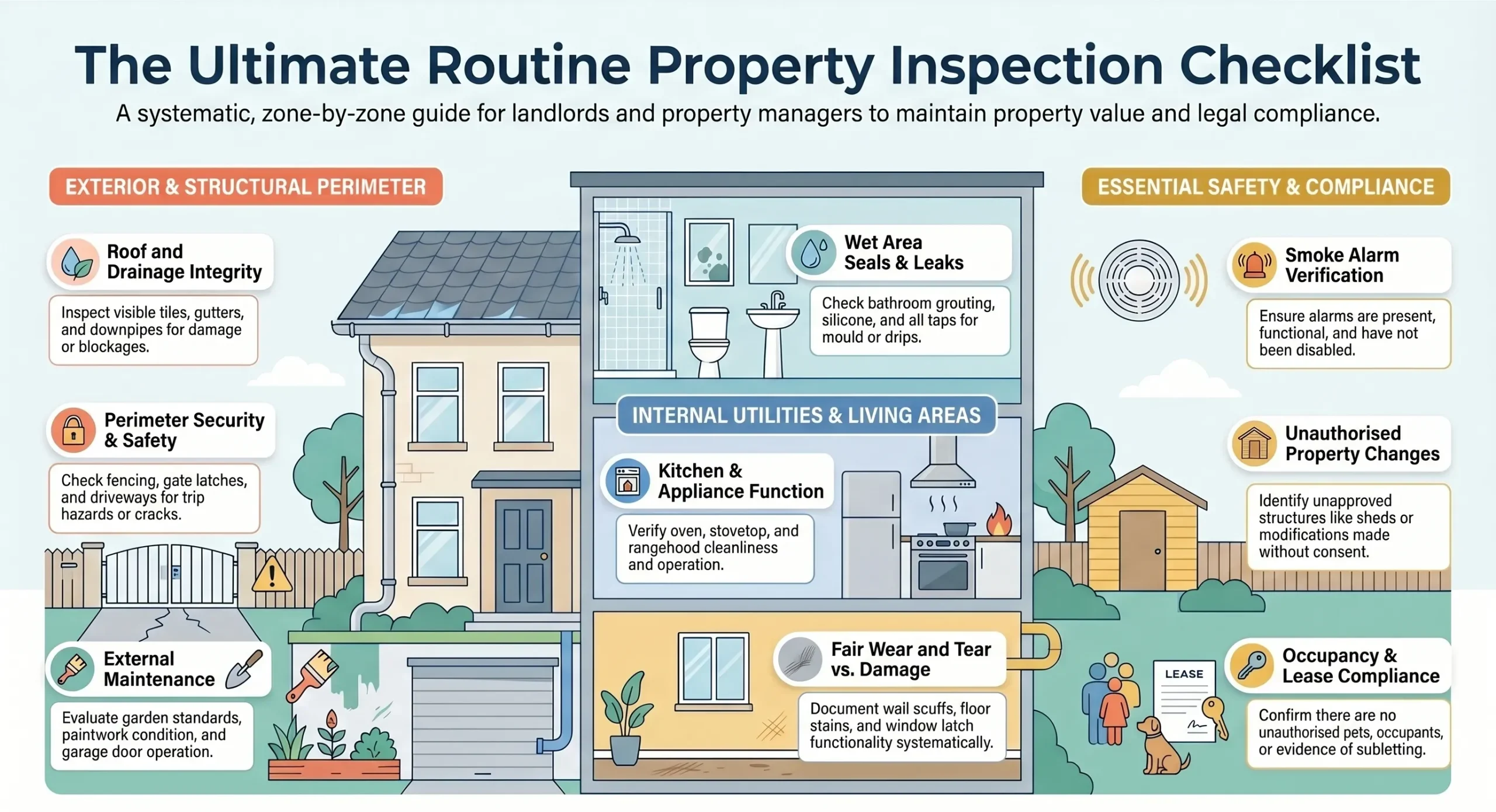
A thorough routine inspection covers every accessible area of the property systematically. Rushing or relying on a visual impression without documentation is a mistake that frequently costs landlords at NCAT.
Exterior
- Roof condition — visible tiles, gutters, downpipes
- Fencing — condition, security, gate latches
- Driveway and pathways — cracks, trip hazards, drainage
- Garden and lawns — maintained to lease standard
- External paintwork — peeling, fading, damage
- Garage door — operation and security
- Any signs of unauthorised structures — sheds, pergolas, outbuildings
Entry and Common Areas
- Front door — operation, locks, security
- Flooring — condition, staining, damage
- Walls and ceilings — cracks, water marks, holes, scuffs beyond fair wear and tear
- Light fittings — working, correct bulbs
- Smoke alarms — present, functional, not covered or disabled
- Windows and flyscreens — intact, latches working
Kitchen
- Benchtops — no burns, chips or water damage
- Cupboard doors and drawers — hinges and handles intact
- Oven, stovetop, rangehood — clean and functioning
- Sink and taps — no leaks, adequate water pressure
Bathrooms and Laundry
- Grouting and silicone — condition, mould
- Taps, showerheads, toilets — no leaks or drips
- Exhaust fans — functioning
- Washing machine connections — no leaks
Bedrooms
- Built-in wardrobes — doors, rails, shelving intact
- Windows — operation, latches, curtains or blinds
- Carpet or flooring — condition, no staining beyond wear
Overall Compliance
- No unauthorised occupants
- No pets present if not approved
- No evidence of subletting
- No modifications made without written consent
How to Document an Inspection Properly
Documentation quality determines your position at NCAT. Verbal observations are not evidence. Photographs without timestamps are weak evidence. A systematic, timestamped, written record with photographs is strong evidence.
Photography Best Practice
- Photograph every room, every defect, and every area of concern
- Use a device that automatically embeds date and time in the image metadata
- Capture wide shots of each room AND close-up shots of any specific issues
- Photograph smoke alarms, locks, and any inclusions listed in the lease
- For any damage or maintenance issue, photograph against a reference point for scale
Written Report
Your inspection report should record:
- Date, time, and name of person who conducted the inspection
- Property address and tenancy details
- Condition of each area inspected — room by room
- Any maintenance issues identified with description and severity
- Any lease compliance concerns
- Actions required and timeline
Provide a Copy to the Tenant
While not legally required, providing a copy of the inspection report to the tenant after each inspection is best practice. It demonstrates transparency, allows the tenant to raise any factual disagreements promptly, and creates a paper trail showing the tenant was made aware of any issues or requirements.
What to Do When You Find Problems
Maintenance Issues
Step 1: Photograph and document the issue at the time of inspection. Step 2: Assess urgency — urgent repairs must be actioned immediately. Non-urgent issues should be scheduled within 14 business days. Step 3: Notify the tenant in writing of the issue and the planned rectification timeline. Step 4: Arrange the repair through a licensed tradesperson and keep the invoice. Step 5: Follow up at the next inspection to confirm completion.
Lease Compliance Issues
If you identify a breach — unapproved pet, unauthorised occupant, unapproved modification, or damage:
Step 1: Document thoroughly with photographs before leaving. Step 2: Issue a formal written breach notice. NSW law requires this gives the tenant a specified period to remedy — typically 14 days. Step 3: Conduct a follow-up visit with appropriate notice to confirm remedy. Step 4: If the breach is not remedied, apply to NCAT.
For any unauthorised changes, you may need to issue a breach notice or negotiate a lease amendment. For suspected illegal activities, it is best to seek advice from a professional property manager or legal counsel, and in some cases you may need to notify the police. Avoid confronting tenants directly, as this can escalate tensions and increase legal risk.
What Tenants Can and Cannot Do During an Inspection
Tenants have the right to be present during any inspection. They cannot be required to leave. Tenants have the right to quiet enjoyment of their home, which means landlords and agents cannot enter the property without proper notice or a valid reason.
Can a Tenant Refuse Access?
A tenant cannot unreasonably refuse access once proper notice has been given. If a tenant unreasonably refuses entry after proper notice, you may apply to NCAT for an order permitting access.
A tenant may legitimately request a different time if the proposed inspection time is genuinely inconvenient. Reasonable accommodation of tenant scheduling preferences is good property management practice.
What Happens If You Enter Without Proper Notice
If you access the property without proper notice, tenants have the right to make a complaint to NSW Fair Trading, and you could face penalties or even compensation orders. This is not a theoretical risk — the financial and reputational cost of a single compliance breach significantly exceeds the inconvenience of scheduling inspections correctly.
Fair Wear and Tear vs Damage: Knowing the Difference
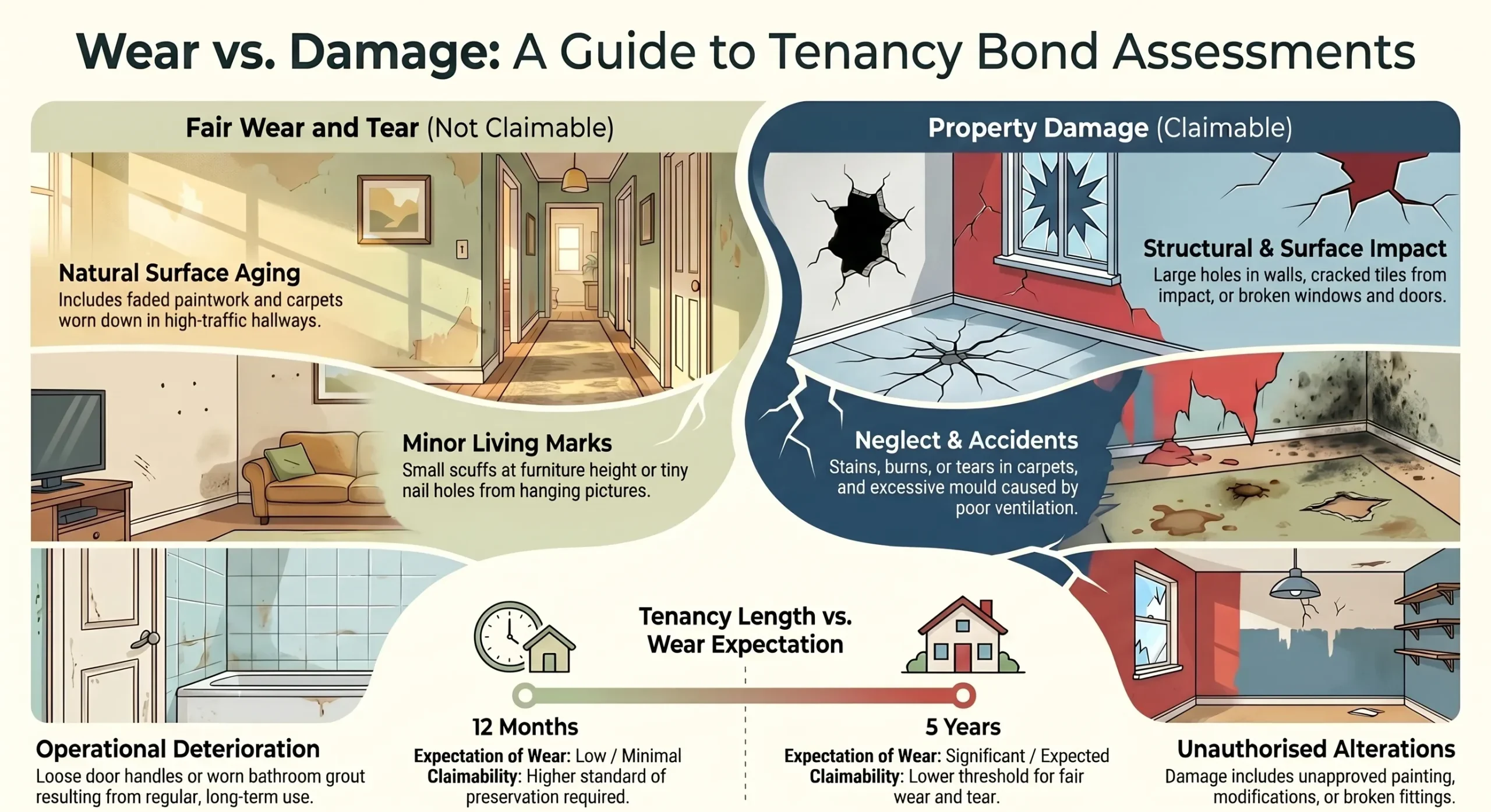
Understanding this distinction is essential for both routine inspections and end-of-tenancy bond assessments.
| Fair Wear and Tear (not claimable) | Damage (claimable) |
|---|---|
| Faded paintwork after several years | Large holes or gouges in walls |
| Worn carpet in high-traffic hallways | Burns, stains or tears in carpet |
| Minor scuffs on walls at furniture height | Broken windows, doors or fittings |
| Loose door handles from regular use | Unapproved painting or modifications |
| Small nail holes from hanging pictures | Excessive mould from poor ventilation |
| Worn grout in bathrooms after years of use | Cracked tiles from impact |
The longer a tenancy, the more fair wear and tear you must accept. A tenant who has lived in a property for five years will leave more wear than one who has occupied it for 12 months — and the standard for what is claimable adjusts accordingly.
The Entry Condition Report: Your Most Important Document
The routine inspection process begins before the tenancy starts — with the entry condition report. This document records the precise condition of the property on the day the tenant moves in and is the benchmark against which all subsequent inspections and the final bond assessment are measured.
A detailed rental inspection checklist with documented proof of the property’s condition at move-in is your best defence against unfair deductions at move-out under the Residential Tenancies Act 2010. Without a clear rental inspection checklist record, a landlord could attempt to charge for pre-existing damage.
A thorough entry condition report includes:
- A written room-by-room description of condition
- Timestamped photographs of every room and every pre-existing issue
- The tenant’s signature confirming review, with any disagreements noted
- A copy provided to the tenant
How Professional Property Managers Handle Inspections in Western Sydney
While it might seem manageable to oversee routine rental inspections yourself, the reality is that managing them effectively takes time, expertise and up-to-date legal knowledge. A professional property manager provides peace of mind by scheduling and managing inspections, ensuring all legal notice periods are met, and using a detailed landlord property inspection guide to assess the home thoroughly.
In Western Sydney’s geographically spread market — Penrith to Parramatta to Blacktown — professional property managers conduct inspections during business hours without requiring landlord attendance, delivering detailed photographic reports to a landlord portal within 24 to 48 hours of every inspection.
Free Routine Inspection Report Template NSW
Property Address:
Inspection Date:
Tenant Name:
Inspector:
Exterior:
□ Good
□ Maintenance Required
Kitchen:
□ Good
□ Maintenance Required
Bathroom:
□ Good
□ Maintenance Required
Compliance Issues:
________________
Maintenance Required:
________________
Photos Attached:
□ Yes
□ No
Inspector Signature:
Let Real Homes Realty Handle Your Inspections
Managing routine inspections correctly takes time, legal knowledge, and attention to detail. For Western Sydney landlords with investment properties in Penrith, Blacktown, Parramatta, Kellyville, or Jordan Springs, delegating inspections to a professional property manager ensures every inspection is compliant, thorough, and properly documented.
Real Homes Realty conducts inspections using digital reporting software, delivering timestamped photographic reports to your landlord portal within 24 to 48 hours of every inspection.
👉 Get a free rental appraisal for your Western Sydney property 👉 Contact our property management team today
Related Reading
- The Complete Guide to Property Management in Western Sydney (2026)
- Landlord Rights and Responsibilities NSW 2026
- How to Find Quality Tenants in Penrith and Blacktown
External Resources
- NSW Government — Minimum Notice Periods for Access to Rental Property
- NSW Fair Trading — Entry to Rental Property
- NCAT — Residential Tenancy Applications