
Written by the Real Homes Realty Property Management Team | Last updated: May 2026
Self-managing vs hiring a property manager is one of the most debated decisions in Australian property investment — and one of the most frequently made on incomplete information. Most landlords who consider self-management focus on the fee they save. Most who end up regretting it did not account for the time it costs, the legal exposure it creates, or the financial impact of the decisions they made without professional guidance.
This guide gives you an honest assessment of both options — written by a property management agency that has a commercial interest in one answer, but a professional obligation to give you the accurate one.
For a broader overview of property management across Western Sydney, read our Complete Guide to Property Management in Western Sydney (2026).
- The Real Question Is Not “Which Is Cheaper?”
- What Self-Managing Actually Involves
- The Time Cost of Self-Management
- The Financial Comparison: Self-Managing vs Professional Management
- The Legal Risk of Self-Management in 2026
- The Case for Self-Management: When It Actually Works
- What Professional Property Management Delivers That Self-Management Cannot Easily Replicate
- A Practical Decision Framework for Western Sydney Landlords
- The Hybrid Option: Starting Professional, Transitioning to Self-Management
- Making the Decision That Is Right for Your Situation
The Real Question Is Not “Which Is Cheaper?”
The most common framing of this decision is financial: how much do I save by self-managing? This is the wrong question. The right question is: what is the total cost — in money, time, and risk — of each option over a two to five year period?
While self-management can save money, it often comes at the cost of time, effort, and potential legal headaches. On the other hand, property managers provide expertise and convenience, but not without fees and risks of their own.
While management fees typically range from a small percentage of weekly rent, the cost of mistakes, vacancies, or legal issues can far exceed those fees. The decision is not just about saving money — it is about protecting your investment.
The landlord who saves $1,800 in management fees per year but spends six hours per month managing their Penrith property has effectively paid themselves $25 per hour for work that requires legal knowledge, dispute management expertise, and 24/7 availability. The landlord who saves the same $1,800 but places a poor tenant and spends four months recovering the situation has actually lost thousands.
What Self-Managing Actually Involves
Before comparing costs, it is important to understand what self-management actually requires. When choosing to self-manage a property, landlords take on a range of responsibilities associated with the day-to-day operations of leasing and maintaining their rental property.
In practice, self-managing a Western Sydney rental property involves:
Finding and Placing Tenants
- Advertising on realestate.com.au and domain.com.au — standard listing fees apply
- Responding to all enquiries, scheduling and conducting inspections
- Processing applications, verifying employment and income
- Running TICA and National Tenancy Database checks
- Conducting reference checks with previous landlords
- Preparing and executing the tenancy agreement
- Completing a thorough entry condition report with photographs
- Lodging the bond with NSW Fair Trading’s Rental Bonds Online within 10 business days
Ongoing Management
- Collecting rent weekly and managing any arrears immediately
- Coordinating all maintenance and repair requests
- Conducting up to four routine inspections per year with 7-day written notice each
- Managing lease renewals and rent increase notices (60 days written notice, once per 12 months)
- Staying current with all NSW tenancy law changes
- Processing pet applications within 21 days under the 2025 reforms
- Maintaining written records of all communications
Dispute Management and Compliance
- Issuing formal breach notices under the Residential Tenancies Act when required
- Applying to NCAT when disputes cannot be resolved
- Completing the mandatory tenancy end reason report via Rental Bonds Online within 14 days of bond claim
- Managing bond claims at the end of each tenancy
Managing a property is more than a quick weekend job — it is a real business.
The Time Cost of Self-Management
Time is the most underestimated cost of self-management. Managing enquiries, conducting inspections, coordinating repairs, handling paperwork, and staying compliant can quickly become a second job, especially if issues arise outside business hours.
Realistic Time Estimates for a Western Sydney Rental Property
| Activity | Estimated Annual Time |
|---|---|
| Tenant placement (advertising, inspections, screening, paperwork) | 15–25 hours (per tenancy) |
| Rent collection and arrears follow-up | 3–6 hours |
| Maintenance coordination (requests, quotes, tradespeople) | 8–15 hours |
| Routine inspections (3 per year, including travel and report) | 9–12 hours |
| Lease renewal and rent review administration | 2–4 hours |
| Compliance administration (notices, records, bond) | 3–5 hours |
| Dispute management (if applicable) | 5–40+ hours |
| Total (no disputes, tenant retained) | 25–45 hours/year |
| Total (one tenancy change, minor dispute) | 50–90 hours/year |
At 50 hours per year, self-managing a $510/week Penrith house at a 6% management fee savings of $1,587 per year gives you an effective hourly rate of approximately $32 per hour — before accounting for the value of your time, the stress component, or any mistakes that have a financial cost.
For most working professionals in Western Sydney, this calculation makes professional management the obvious choice. For retired landlords with time, proximity, and genuine interest in property management, the calculus may be different.
The Financial Comparison: Self-Managing vs Professional Management
Annual Cost Comparison — $510/Week Penrith House
| Cost Item | Self-Managed | Professionally Managed (6.5%) |
|---|---|---|
| Management fee | $0 | $1,722 |
| Letting fee (per tenancy, amortised over 2 years) | $0 (your time) | $382 |
| Advertising (realestate.com.au listing) | $200–$400 | Usually included |
| TICA/NTD database checks | $30–$60 | Usually included |
| Professional photography | $200–$300 | Usually included |
| Routine inspections (3 per year) | $0 (your time) | Usually included |
| Lease preparation | $0 (your time) | Usually included |
| Bond lodgement administration | $0 (your time) | Usually included |
| Estimated annual cash cost | $430–$760 | $2,104 |
| Your time (50 hrs at $32/hr implied) | $1,600 | ~0 |
| True annual cost | $2,030–$2,360 | $2,104 |
When time is costed honestly, the financial gap between self-management and professional management for a single Western Sydney property is narrow — and disappears entirely once any dispute, vacancy extension, or compliance issue is factored in.
Where Self-Management Loses Its Cost Advantage
Extended vacancy: Consider longer vacancy periods due to less effective marketing and higher repair bills because you lack a network of trusted tradespeople. A professionally managed property in Western Sydney is typically listed on realestate.com.au with professional photography and premium placement, leasing within one to three weeks. A self-managed property listed with smartphone photos in a standard placement may take three to five weeks — costing $1,530 to $2,550 in lost rent.
Mispriced rent: Without access to current comparable data, self-managing landlords frequently overprice or underprice their properties. Overpricing by $30/week results in three to four weeks of additional vacancy — costing $90 per week of attempted gain while losing $90 per week of vacancy. A professional rental appraisal is free.
Compliance breach costs: Mishandling bond lodgement, issuing an incorrect notice, or breaching tenancy laws can result in fines or tribunal action. A single compliance breach — an incorrectly issued termination notice, a missed 21-day pet response deadline, a bond not lodged within 10 business days — can result in financial penalties and NCAT orders that far exceed a full year of management fees.
Bad tenant placement: Without TICA checks, professional reference verification, and income ratio analysis, self-managing landlords place problem tenants at a higher rate than professional agencies. Property managers perform comprehensive background checks, reducing the risk of problematic tenants and ensuring a reliable rental income stream.
The Legal Risk of Self-Management in 2026
NSW tenancy law is more complex in 2026 than at any point in the past decade. The 2025 reforms introduced sweeping changes — no-grounds evictions banned, pet application rules, mandatory Centrepay, enhanced notice requirements, mandatory tenancy end reason reporting — that most self-managing landlords are not fully across.
Landlord-tenant law in NSW can be complex and subject to frequent changes. Ensure you are familiar with the current regulations, including the Residential Tenancies Act and any upcoming laws scheduled to take effect in 2025.
The Specific Risks for Western Sydney Landlords
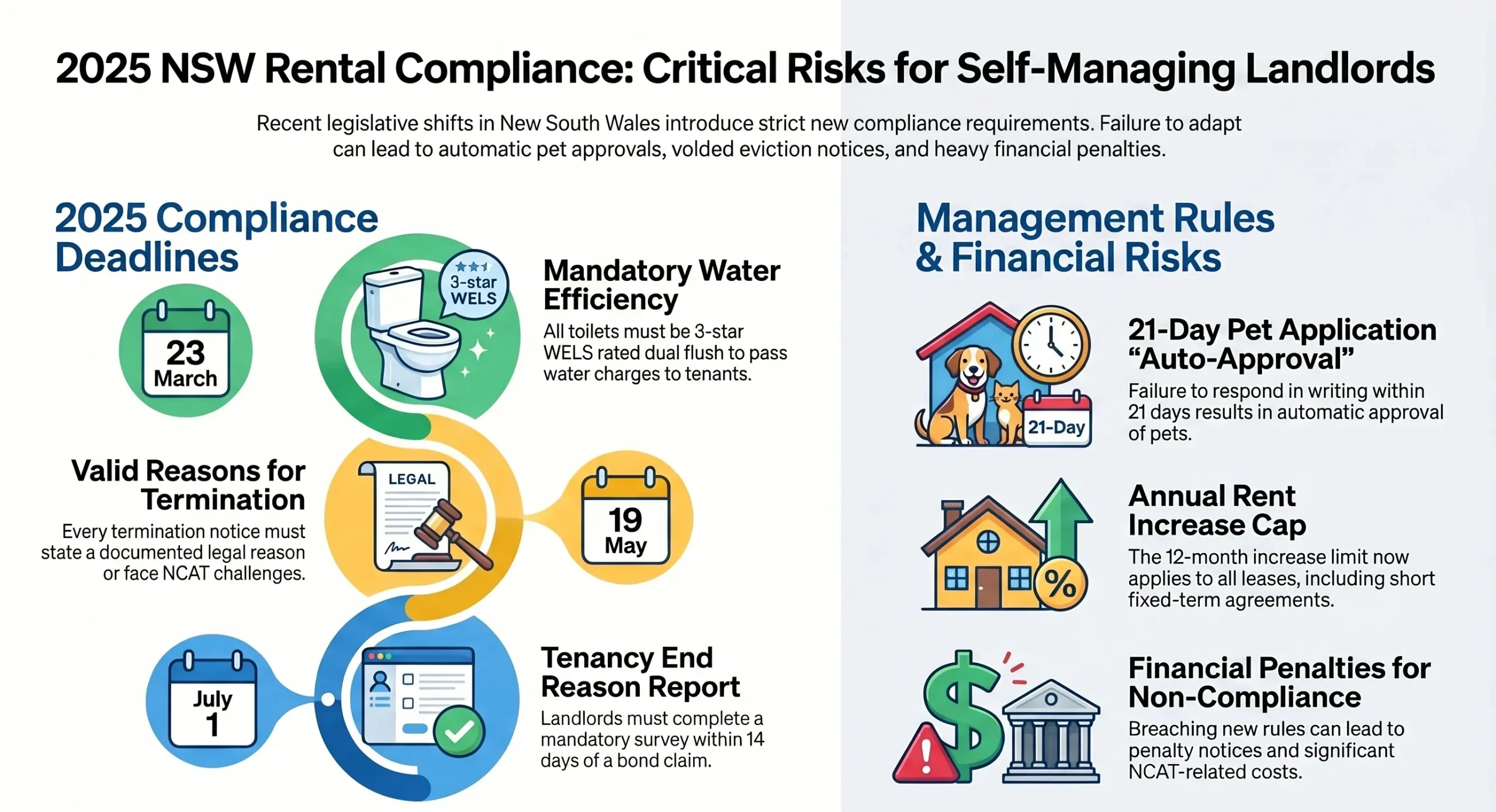
Pet application auto-approval: If you receive a pet application and do not respond in writing within 21 days, the pet is automatically approved — regardless of the reason for the delay. Many self-managing landlords are unaware of this rule.
Invalid termination notices: Since 19 May 2025, every termination notice must state a valid, documented legal reason. An invalid notice can be challenged at NCAT within 90 days. The cost of a failed eviction — additional weeks of tenancy plus NCAT costs — is significant.
Mandatory tenancy end reason report: From 1 July 2025, landlords must complete a survey in Rental Bonds Online explaining why a tenancy ended, within 14 days of the bond claim. NSW Fair Trading can issue a penalty notice for non-compliance. Most self-managing landlords are unaware this requirement exists.
Water efficiency compliance: From 23 March 2025, all toilets in NSW rental properties must be dual flush with a minimum 3-star WELS rating. Non-compliant landlords cannot pass water usage charges to the tenant.
Rent increase frequency: The once-per-12-months cap now applies to all lease types including fixed-term leases under two years — a change from the previous rules. Self-managing landlords operating on the old understanding could unknowingly breach this requirement.
Rental laws and regulations change regularly. Missing a compliance requirement, mishandling a dispute, or issuing incorrect notices can lead to fines, tribunal disputes, or costly legal mistakes.
The Case for Self-Management: When It Actually Works
This guide is written by a property management agency — so let us be direct about when self-management is genuinely the right choice.
Self-Management Works Well When:
You live close to the property. A landlord who lives five minutes from their investment property in Penrith can respond to maintenance requests quickly, attend inspections without significant time cost, and maintain direct knowledge of the property’s condition.
You have genuine time available. Not theoretical time — actual, regular, reliable time to respond to tenant communications, coordinate tradespeople, and attend to administrative requirements, including outside business hours.
You have current legal knowledge. Not knowledge of how tenancy law worked five years ago — current knowledge of the 2025 reforms, the Residential Tenancies Act 2010, and the specific compliance requirements that apply in NSW in 2026.
You have reliable trade relationships. A self-managing landlord who has trusted, responsive plumbers, electricians, and general handypeople in Western Sydney can manage maintenance cost-effectively. One who does not will spend more time and money on maintenance coordination than a professional agency with an established trades panel.
The tenancy is stable and long-term. Self-management is significantly easier when the same quality tenant has been in the property for three or more years, rent is paid consistently, and maintenance requirements are minimal.
You own one property. If you have less time to spend on property matters and want fewer headaches, it is pragmatic to hire a good property manager to manage one’s property/ies. Self-management of a single property is substantially more manageable than self-managing two or more properties simultaneously.
Self-Management Is High Risk When:
- You are an interstate investor or live more than 30 minutes from the property
- You have a full-time job and limited flexible time
- You are unfamiliar with current NSW tenancy law
- You own multiple investment properties
- The property has older infrastructure requiring active maintenance management
- You have no existing relationship with reliable local tradespeople
- A dispute is already in progress or likely
What Professional Property Management Delivers That Self-Management Cannot Easily Replicate
Market Intelligence
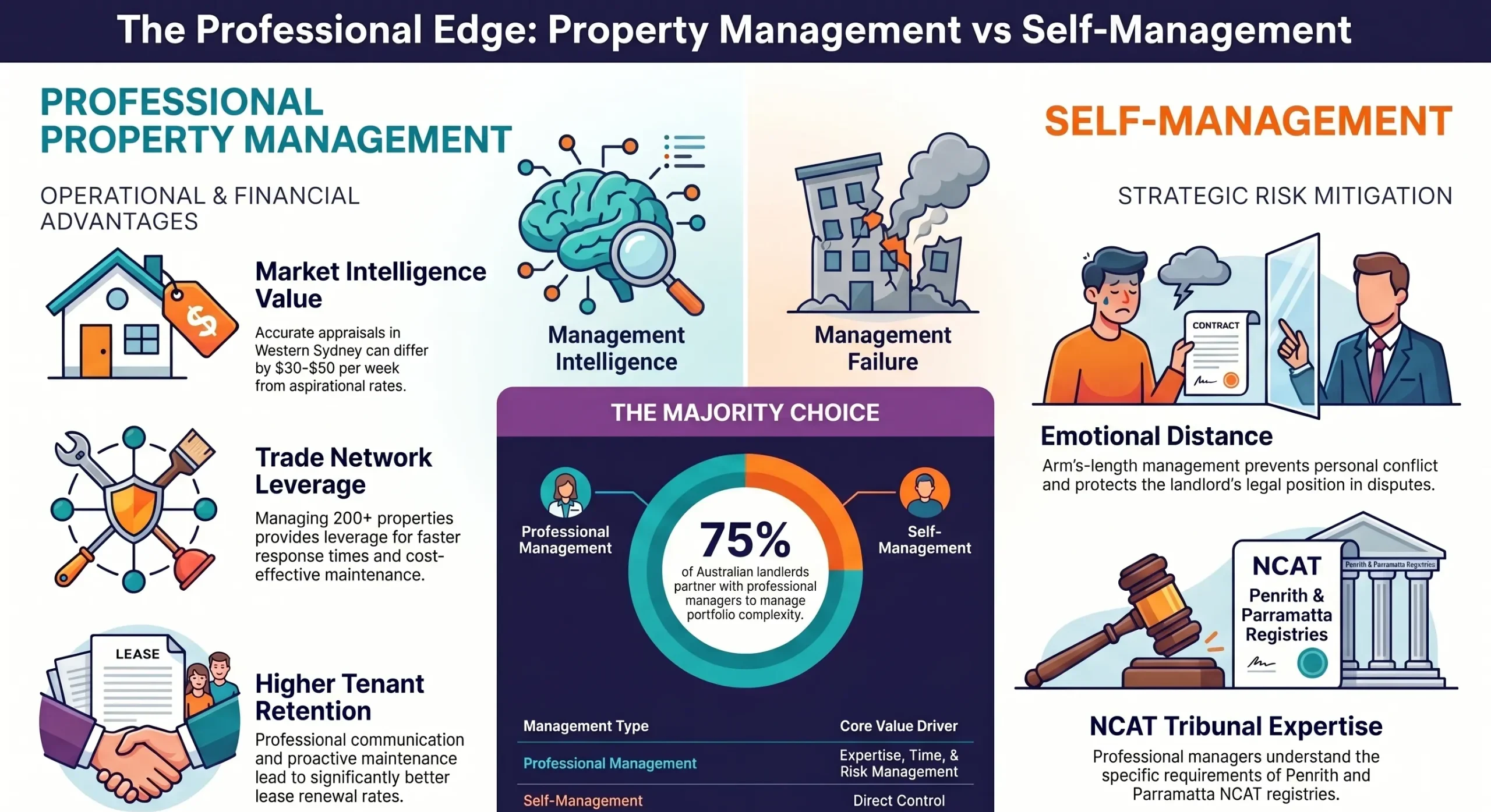
Property managers have access to market data and trends that allow them to set competitive rental rates and attract high-quality tenants. In Western Sydney’s 2026 rental market — where the difference between an accurate and an aspirational rental appraisal can be $30 to $50 per week — this market intelligence has direct financial value.
Trade Networks
Established relationships with contractors and service providers can result in quicker and often more cost-effective maintenance and repairs. A professional agency managing 200 properties in Western Sydney has leverage with local tradespeople that a self-managing landlord cannot replicate. Response times are faster, pricing is often better, and the quality of work is more consistently reliable.
Emotional Distance
Tenant relationships managed at arm’s length by a professional are less likely to result in overly accommodating decisions about rent arrears, less likely to escalate into personal conflict, and less likely to result in communication that could harm a landlord’s legal position in a dispute.
Prompt responses to tenant requests and proactive maintenance contribute to higher tenant satisfaction and retention. A property manager who handles tenant communication professionally and consistently achieves better lease renewal rates than a self-managing landlord who responds inconsistently or becomes frustrated in communications.
NCAT Experience
A property manager who regularly appears at the Penrith and Parramatta NCAT registries understands what Tribunal Members look for, how conciliation typically unfolds, and how to prepare a case efficiently. This experience is not available to most self-managing landlords and represents genuine value in any dispute situation.
Approximately 75% of Australian Landlords Choose Professional Management
In 2023, approximately 75% of landlords currently partner with property managers. This figure reflects the considered decision of the majority of Australian property investors — that the time, expertise, and risk management value of professional property management outweighs the fee cost, particularly as portfolio size and property complexity increase.
A Practical Decision Framework for Western Sydney Landlords
Use this framework to assess your situation honestly:
Question 1: How much time do you genuinely have?
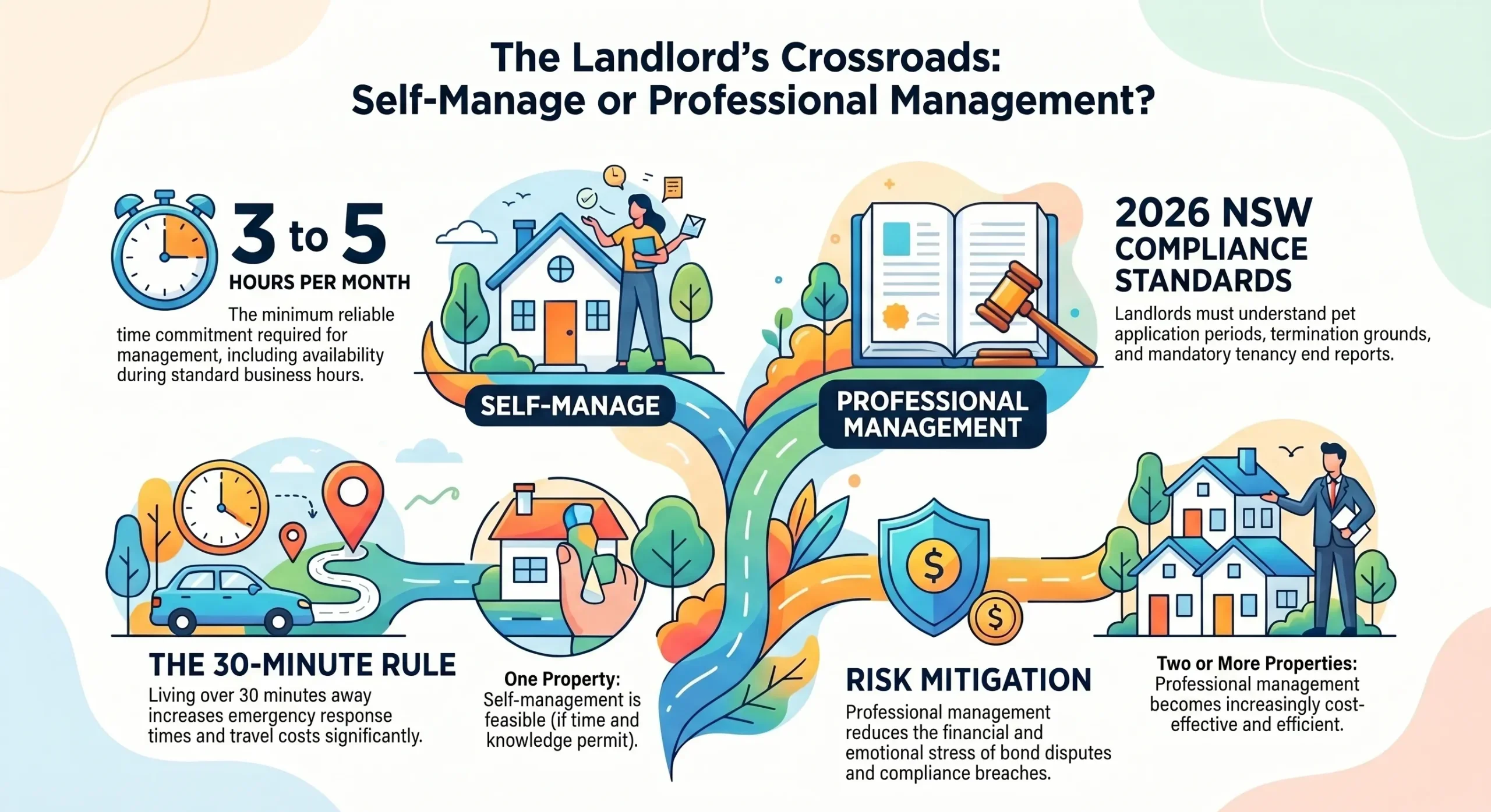
If you cannot reliably commit 3 to 5 hours per month to property management — including during work hours when tradespeople are available — professional management is the right choice.
Question 2: How current is your legal knowledge?
If you cannot answer these questions confidently, you need professional management:
- What are the valid grounds for ending a tenancy in NSW in 2026?
- What is the mandatory pet application response period?
- What is the mandatory tenancy end reason report and when must it be submitted?
- What notice period applies to a periodic tenancy termination for owner occupation?
Question 3: How close do you live to the property?
If more than 30 minutes away, self-management significantly increases your response time to maintenance emergencies and inspections. Consider whether that time and travel cost is worth the management fee saving.
Question 4: How many properties do you own?
One property: self-management is feasible if questions 1 to 3 are answered positively.
Two or more properties: professional management becomes increasingly efficient and cost-effective relative to your own time.
Question 5: What is your risk tolerance?
Self-management carries legal and financial risk that professional management significantly reduces. If a compliance breach, a bad tenant placement, or a disputed bond claim would cause you material financial or emotional stress, professional management is the appropriate risk mitigation.
The Hybrid Option: Starting Professional, Transitioning to Self-Management
Some Western Sydney landlords choose to begin with professional management — particularly during the first tenancy — and transition to self-management once they have built local knowledge, trade relationships, and experience with the tenancy process.
If you’re unsure, consider starting with a property manager and gradually taking on self-management as you gain experience.
This approach makes practical sense. The first tenancy — advertising, screening, placing a tenant, completing the entry condition report, navigating the first inspection — is where the most can go wrong and where professional guidance has the highest value. A landlord who manages this process professionally the first time builds a strong foundation for confident self-management if they choose to transition.
Making the Decision That Is Right for Your Situation
There is no universal answer to the self-managing vs hiring a property manager question. For some Western Sydney landlords — those with time, proximity, legal knowledge, and stable tenancies — self-management is a reasonable and financially sound choice. For most, particularly those with full-time work commitments, interstate ownership, multiple properties, or limited familiarity with current NSW tenancy law, professional management delivers genuine value that exceeds its cost.
If you want control and you are happy to put in the time and energy it takes, self-management might be your thing. If you would rather have a professional perspective, less stress, and the confidence that your property is being managed by professionals, bringing in a property management company is usually the smarter call.
The most important thing is to make this decision with an accurate understanding of what self-management actually involves — not an optimistic estimate of the easy cases and an underestimate of the hard ones.
👉 Get a free rental appraisal and management proposal from Real Homes Realty 👉 Contact our Western Sydney property management team
Related Reading
- The Complete Guide to Property Management in Western Sydney (2026)
- How to Choose a Property Manager in Western Sydney
- Property Management Fees in Western Sydney: What’s Fair in 2026?
- Landlord Rights and Responsibilities NSW 2026
External Resources
- NSW Fair Trading — Landlord Responsibilities
- NSW Government — Changes to Rental Laws 2025
- Service NSW — Verify a Licence